Fifth Centenary of the Capuchin Reform
1528-2028
Mentem illuminare et cor inflammare
Called to Illuminate the Mind and Inflame the Heart of Our Charism
Table of Contents
- Fifth Centenary of the Capuchin Reform
- 1528-2028
- 1. GENERAL PROJECT
- 2. OUR CAPUCHIN CHARISM
- 3. OUR CAPUCHIN CHARISM
- A Search for the Capuchin proprium in the Constitutions of Saint Euphemia
- Introduction
- Conformity to Christ
- Conformity to Francis
- Penance
- The Eremitical Life
- Silence and Solitude
- Mental Prayer
- Contemplation
- Being Called Capuchins
- Sine proprio
- Austerity
- Minority
- Fraternity
- Manual Labor
- Mendicants
- The Ministry of Mercy
- Evangelical preaching
- Pluriformity
- The Capuchin Proprium as the Foundation of a Capuchin Culture
- Conclusion
- Bibliographical References
Dear Brothers,
Pace e bene!
We are approaching the 500th anniversary of the Capuchin Reform. We want this anniversary to be a propitious occasion of spiritual renewal and personal and communal growth according to the values and charism of our Order, not just an elaborate celebration to be lived on a specific day. To this end, we propose a path of preparation aimed at involving all our friars scattered around the world so that, together as a universal fraternity, we can make this time a time of grace, a great impetus for a new beginning. To begin again does not mean to abandon the past, to break with history, but to continue the journey with renewed fervor and the desire to continue witnessing to the world the beauty of our charism.
During the last meeting of our General Council held in Rome from June 16-27, among the topics discussed was our approval of the agenda for the Lay Brothers’ Meeting to be held in Rome from November 3-10, 2025. The preparatory committee for the IX PCO, to be held in Rome from October 10-31, 2026, was also appointed. We also approved the Project for the 500th Anniversary of the Capuchin Reform. This includes a series of events and programs at the level of the Order, and I present it to you as a guide in preparing for our Order’s great anniversary. This series of events seeks to integrate the various meetings and activities based on a central theme: the living of our charism. In fact, the central theme of the project is this: mentem illuminare et cor inflammare.
It is true that in recent years we have celebrated Franciscan centenaries and still await the one in 2026. Many activities are underway, both at the international level of the Franciscan Family and at the level of the conferences and individual circumscriptions of our Order. We desire that the Project for the 500th anniversary of the Capuchin Reform be an instrument of animation for our Order, involving all our brothers, but also, according to possibilities and feasibility, the Capuchin Poor Clare Sisters and the various institutes affiliated with our Order, the SFO and YouFra.
Because of time constraints, we have envisioned a simple plan encompassing all major Order- level or continent-wide meetings scheduled until 2028. We do not intend to present a closed, prepackaged or finished program. In this plan, we present a PATH and PROCESSES, combined into a PROGRAM that not only allows but also requires the participation of the entire Order through its various conferences and circumscriptions.
Since this is a project in the making, it allows the presidents of the conferences (taking into account the plan indicated here and after consulting the circumscriptions) to offer suggestions and proposals to be presented at their next meeting on September 25 and 26, 2025 in Rome. It is essential that the conferences organize a project within themselves to better live and celebrate this time of grace. We know that some conferences are already working in this direction. There are several possibilities, depending on the circumstances of each conference.
Regarding the Project for the 500th Anniversary of the Capuchin Reform, we will ask in due time for the direct participation of the conferences through themed articles and videos according to the directions we will send. This will be a way to show the whole Order what the conferences are doing in preparation for our Order’s anniversary. To facilitate this preparation process, we have excellent material prepared by the central administration of our Order that can be used by the conferences; we entrust you with an aid that traces back to the origins of our reform.
This text, through a historical, charism-based exploration, seeks to capture some fundamental realities that have given rise to our charism in the world. Themes such as our life of penance, silence, mental prayer, contemplation, among others, are not only themes of the past, but also necessities for the present. Always taking into account the earliest written sources of the Capuchin Reform, the text also offers a study of the Capuchin way of being, presenting themes such as austerity, minority, fraternity and manual labor. No less important is the compelling presentation of how the early friars carried out their ministerial activities in the service of the Church. The ministry of mercy (a hallmark of our Order even today), evangelical preaching accompanied by the necessary witness of life and evangelical communion within the Order, enabled everyone to feel that they were truly brothers and sisters of one universal family in which each contributed to the whole.
Dear brothers, the material we are making available is intended to be a formative tool for all the brothers of the Order. This material marks the beginning of a program to animate the life of the Order in the direction of its centenary in 2028. I kindly ask conference presidents and major superiors to treasure this material, allowing all friars to access and study it. As they look back, may they feel excited to continue walking into the future with joy and hope. May the study of this material be an opportunity to review our current way of living the charism in each circumscription and encourage our desire to update the fundamental characteristics of our way of life in each cultural context.
May the Lord grant all of us the desire to apply ourselves with vigor and authenticity to this rich path of animation and life; and may He bless us with a determined and enthusiastic will to follow ever more closely in His footsteps.
Fraternally,
Br. Roberto Genuin
General Minister OFMCap
Rome, 13 August 2025
Memorial of Bl. Marco d’Aviano
1. GENERAL PROJECT
1. Introduction
We are approaching the anniversary of the birth of our Order. A welcome event involving all the friars scattered around the world to experience an occasion of renewal. We want to offer some recommendations that can help us to live and celebrate this important moment in our history.
The Constitutions of St. Euphemia (1536) contain the life project that the first Capuchins formulated in their quest for fidelity to the Gospel and Franciscan spirituality. Chapter III, insisting on the primacy of prayer and contemplation in our form of life, states that each brother should take diligent care to enlighten his mind and inflame his heart (No. 42), so as to be ready for the action of Him who makes all things new (Cf. Rev. 21:5). The present Constitutions of the Order gather the spirit of the first legislative text and retain the same formal expression (Const. 54:2).
The celebration of the Fifth Centenary of the Capuchin Reform is an occasion to renew in each of the brothers of the Order the desire for fidelity to our charismatic identity, to enlighten our minds, that is, to remember who we are and what are the fundamental characteristics of our way of life, and to inflame our hearts, that is, to live with intensity and joy what we are.
We want to offer some guidelines by trying to link some meetings and events at the international level while at the same time giving space for initiatives at the level of Conferences and Circumscriptions.
2. The “Anniversary of the Capuchin Reform” Logo
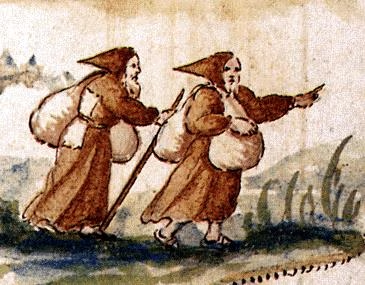
The logo created for the 500th anniversary of the birth of the Order of Friars Minor Capuchin (1528-2028) is a graphic design that blends elements that combine historical notions and momentum toward the future, with a modern visual communication, outlining the journey of an Order that, five hundred years after its founding, still has something to say to the world today. The main graphic element of the logo consists of the drawing of two friars on the way and summarizes the idea of the fraternity that continues to move forward 500 years after the birth of the Order of Friars Minor Capuchin.
The original image, taken from SILVESTRO DA PANICALE’s Capuchin Atlas of 1632 [The Capuchin Historical Institute. Unpublished work by Silvestro da Panicale, 1990, 41], has been simplified and adapted into essential, bold lines in brown. The ancient design is, in this way, made more modern to the eye and may still have the ability to communicate, making visible a path between the old and the new, within Capuchin art and tradition.

Anniversary logo
The profiles of the two walking Capuchins were placed on a sketchy line that recalls the idea of a road and, as a graphic element, divides the pictogram from the logotype.
As mentioned above, the image of the two Capuchins here manifests both the idea of fraternity as diversity, presenting different elements in each individual friar such as the staff, the hood, and the questing bag. The two figures seem to interact as well as move in harmony, cooperating in a kind of synergy that looks toward the future.
Overall, the logo, rendered through such minimalist strokes, does not shout “we have been here for 500 years!” but says, “we are still walking.”
We thank Fr. Angelo Minacapilli of the Province of Sicily for his contribution in creating the logo for the anniversary of the Reform.
3. Celebrations
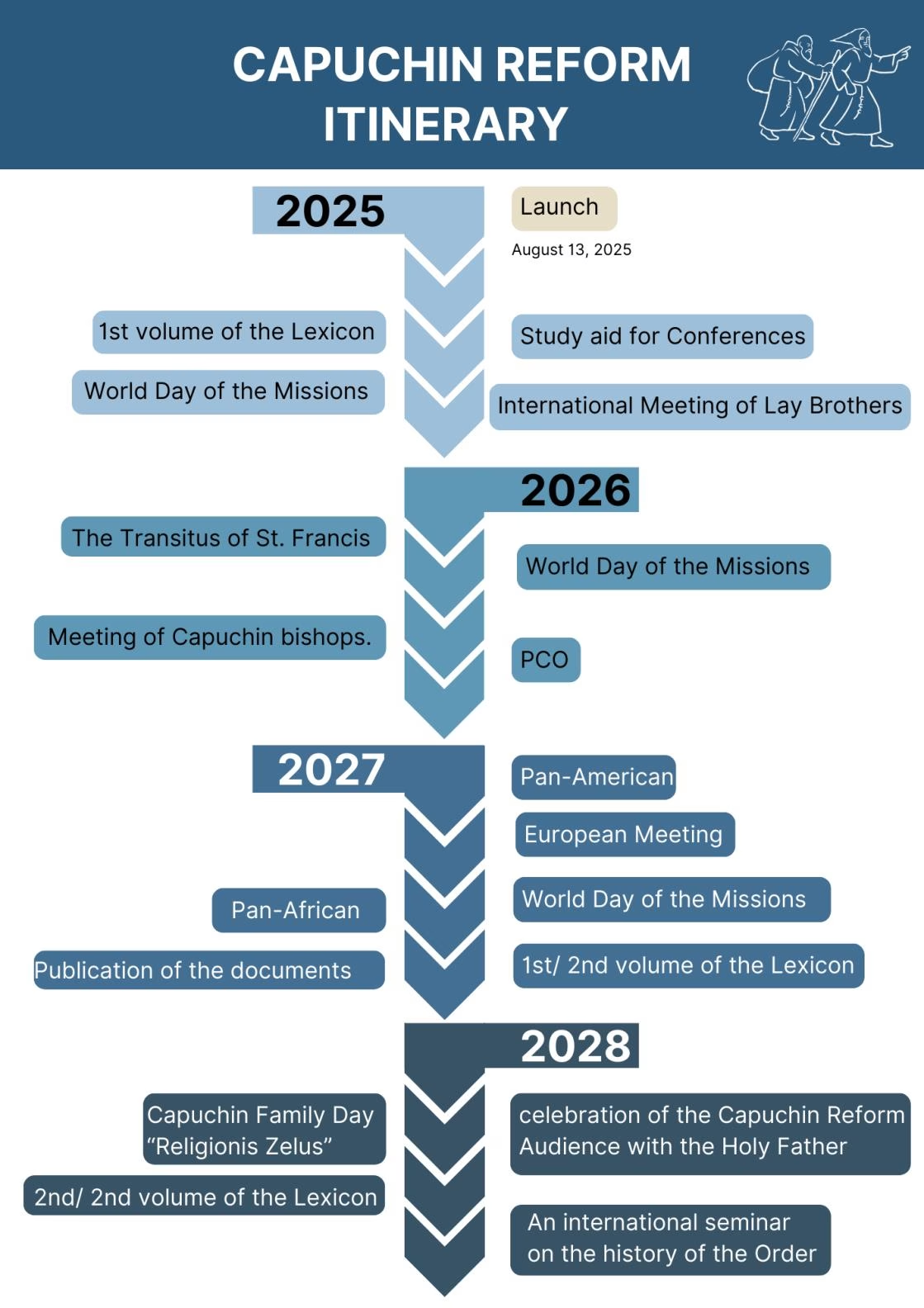
2025
Launch: August 13, 2025
Publication of the General Minister’s letter “Mentem illuminare et cor inflammare” along with its own chart graphics, which will be used to support various events on the journey toward the celebration of the Reform.
World Day of the Missions
This day is scheduled for the entire month of October.
International Meeting of Lay Brothers
Inflaming the heart of our brotherly vocation.
Clement VII’s bull Religionis Zelus (1528) was addressed to brothers Ludovico and Raffaele da Fossombrone, the former a cleric and the latter a layman. This historical detail becomes a symbol of our fraternal vocation and a testimony to the balance between two complementary ways of assuming our charismatic identity.
The International Meeting of Lay Brothers aims to revive our vocation as brothers and minors. It will be an occasion to reflect on what threatens within us the flame of brotherhood and to renew our commitment to fraternity.
Two walking Capuchins
Another celebration entering as part of the Reform project for the year 2025 is the publication of the 1st volume of the Capuchin Lexicon.
2026
The Transitus of St. Francis and Plenary Council of the Order: Collaboration and Mission
Inflaming the Heart of Our Missionary Vocation
Celebration of the Transitus of Saint Francis
The preparation of the PCO is an opportunity to reaffirm the intimate connection between our charismatic identity and our evangelical presence in the world. Without a charismatic identity understood and assimilated by each of the brothers, evangelizing, pastoral and/or missionary initiatives would not only be spiritless, but could turn into activism, individualism, pursuit of prestige and economic gains, distorting our way of life.
Recommendations on a Conference Level: It’s been 800 years since the death of St. Francis. We desire, like the first Capuchins, to return to Francis. We shall be open to all initiatives that will help to put the Poverello of Assisi at the center of our lives. In particular, we propose the reading and in- depth study of the three fundamental texts that encapsulate the Franciscan charism: the two Rules – whose eighth centennial we recently celebrated and which have inspired numerous recent studies – and the Testament, which celebrates its 800th anniversary in 2026.
Let us not forget that we Capuchins have been called “The Brothers of the Testament” because of the importance our early brothers attached to it. It would be desirable that all retreats, spiritual exercises, continuing formation courses, conferences, formation meetings and spiritual readings have at their center the figure of St. Francis of Assisi. A sincere return to him in the 800th year since his death will be the best way to celebrate this important anniversary.
Another celebration entering as part of the Reform project for the year 2026 is the meeting of Capuchin bishops.
2027
Pan-African & Pan-American
Inflaming the Heart of Our Capuchin Culture
The meetings of the Conferences of each continent are intended to reflect on the way we are living our charismatic identity in each cultural context and to propose ways of fanning the flame of our charism. It is also an opportunity to review and rethink the structures that support our way of life, to organize programs for common formation, and to bring about possibilities for collaboration among circumscriptions.
These meetings will also be an opportunity to reflect on our common Capuchin culture (RF, Annex I, 15-16), understood as a concrete way of shaping our charismatic identity in every cultural context, without allowing cultural contexts to absorb, distort or trivialize our way of life, and seeking to permeate these contexts with the witness of our vocation as Capuchin Friars Minor (Const. 147:2).
Recommendations on a Conference Level: this will be the year to reacquaint ourselves with the Capuchin Reform. We shall be open to all initiatives that help us to learn more about our Reform. In particular, we propose the study of the First Capuchin Constitutions, known as the Constitutions of St. Euphemia, and the reading of texts on the history of the Reform. It would be wonderful if, during the current year, all the friars would personally read the First Constitutions, which have guarded the Capuchin identity for more than four centuries. Each circumscription will need to ensure that all the friars have available an accessible and faithful translation of this text. In addition, it will be important that retreats, recollection days and occasions for ongoing formation be dedicated to themes related to our Reform.
Other celebrations that enter as part of the Capuchin Reform project for the year 2027 are the meeting of European Capuchin Conferences, the publication of the 1st part of the 2nd volume of the Capuchin Lexicon, and other documents on our history and the Constitutions.
2028
Celebration of the Fifth Centenary of the Capuchin Reform
Inflaming the Heart of Our Charismatic Identity
At an international level, two activities will be planned for in Rome:
-
-
- An international seminar on the history of the Order (Historical Institute)
- A celebration with the presence of the Holy Father (International College)
-
Recommendations on a Conference Level: the year in which we will celebrate the 500th anniversary of the canonical approval of our Order, will be the year to “understand” that the Reform is alive and must continue. This year will be dedicated to reading, studying and gaining a deeper understanding of the current Constitutions, the PCOs, and the Ratio Formationis, concrete tools to keep alive, today, our original inspiration.
The many events of the Order during these years – such as the meeting of lay brothers, the PCO on mission, the continental meetings, the gatherings of formandi and formators, the Capuchin Family Days – should all contribute to living this jubilee fully.
Celebration of the Year of the Reform: For the celebration of the 500th anniversary of the Reform, we propose:
-
-
- Make visible the different projects and initiatives articulated by the conferences. – The possibility of a letter or message from the General Minister concerning the Reform.
- Develop in concise articles the essential values of our charism (cf. Const. 4:2-5:4.).
- An initiative for the celebration of July 3, the day of the publication of the bull “Religionis Zelus” which for the. past nine years has been celebrated as Capuchin Family Day.
- An international seminar on the history of the Order.
- Recurring social media postings throughout the year on the celebration of theCapuchin Reform.
- Audience with the Holy Father; exercise of reflection regarding his message.
- Another celebration that enters as part of the Capuchin Reform project for the year 2028 is the publication of the 2nd part of the 2nd volume of the Capuchin Lexicon.
-
4. Program
2. OUR CAPUCHIN CHARISM
Suggestions for using the material
1. Scrutiny of our current way of living the Capuchin charism: The material offers information on our history and charism that allows us to establish a parallel between the way we live our charism in each fraternity and circumscription and the form of life that defines our Capuchin identity. In other words, the material can be useful in promoting an evaluation that allows the brothers, gathered in a chapter or local assembly, to answer the following questions: Are we living according to the Capuchin form of life? What characteristics of our Capuchin charism have we forgotten or neglected? What elements external to our Capuchin charism have we adopted as our own?
2. Actualization of the fundamental characteristics of our charism: The material suggests elements for embodying our form of life, that is, actualizing the identifying traits of our Capuchin tradition. After understanding the meaning of each of the characteristics of our charism, one can try to answer the following questions: How do we translate the identifying traits of our form of life into our cultural context? How do we make the characteristics of our charism visible and credible? How do we rekindle, that is, bring back to life those characteristics that we have forgotten or neglected?
3. Strengthening the programs of initial and ongoing formation: Restructure and actualize the formation programs of each circumscription based on the fundamental characteristics of our form of life. That is to say, prioritize the embodiment of the identifying traits of our form of life in formation programs, since the purpose of any formation process is to learn to live in accordance with our charism. The material can also help structure the Ratio Formationis Localis, since the priority of our form of life must be emphasized in all areas of formation. Reflection can be based on the following questions: Are our initial and ongoing formation programs structured according to the fundamental characteristics of our charism? Do our formation programs guarantee fidelity to our Capuchin tradition? Do our formation programs promote the actualization of the identity traits of our way of life in the cultural context in which we live?
The above are just a few suggestions (among many others that many of you could probably identify or conjure up); they are suggestions aimed at promoting a reflective, participatory an purposeful interpretation that relates to three important concerns of our form of life: scrutiny/re-evaluation, actualization/revitalization and initial and ongoing formation.
3. OUR CAPUCHIN CHARISM
A Search for the Capuchin proprium in the Constitutions of Saint Euphemia
[…] There let them endeavor to become inflamed as the Seraphim,
with divine love, so that, all aflame themselves,
they may enkindle others.
(Constitutions of Saint Euphemia, 120)
Introduction
- The initial letter that the General Minister sent to all the brothers of the Order at the start of the sexennium exhorts us to contemplate the beauty of our charismatic identity and, at the same time, invites us to center our gaze on the fundamental characteristics of our way of life (i.e., prayer, fraternity, and mission). This letter, like those written by St. Paul or St. Francis of Assisi, reflects a specific context, particular problems, and at the same time, presents a series of propositions to respond to the demands of the current times, in this case, of our universal fraternity.
- The lack of care in the life of the spirit by some local fraternities, the disenchantment that many brothers feel toward our way of life, the abandonment of the Order by more than a few perpetually and temporarily professed, the difficulties in the affectual and sexual life of the friars, problems related to the transparent use of economic resources, conflicts and painful interpersonal ruptures among the brothers, and the progressive assimilation of values, customs, or cultural practices that are distanced from our way of life, are some of the realities that hurt our Capuchin identity in the different geographical contexts and cultures where we make ourselves present. The letter of the General Minister may be considered a global reflection of this painful reality which has weakened our being and living in the world.
- Insistence on the primacy of prayer, the cultivation of an authentic fraternal life, and the promotion of missionary activity as an expression of our way of life, as it is outlined in the General Minister’s letter, points us to the fundamental traits of our charismatic identity, to those characteristics that define our particular way of living the Gospel, and the Franciscan spirituality in the Church and in the world. The proximity of the Fifth Centenary of the Capuchin Reform is a moment of grace and an opportunity for us to return[1] to the source of our charismatic identity and revive, above all, the flame of our charism that allows us to live with joy and faithfulness the gift of being Capuchin lesser brothers.
- The causes that have contributed to the distortion and weakening of our Capuchin identity are twofold: forgetfulness and ignorance. Forgetfulness supposes that at some point, perhaps in the years of initial formation, we learned the fundamentals of our way of life. However, with time, the influence of other lifestyles, lack of study, reflection, and renewal of our charism, pastoral worries, and other motives, many though they be, have gradually distanced us from our charismatic origins, and have instilled in us a way of life that is significantly astray from our charismatic identity. Ignorance, on the other hand, implies that we have not had the opportunity to deeply know the defining characteristics of our way of life, whether due to a lack of structure or superficial processes of formation, the influence of other spiritualities, seminary-style formation, or by the excessive emphasis on the clerical dimension, among other factors.
- Returning to the origins, as the first Capuchins did, is a true antidote against both forgetfulness and ignorance. We do not just return to the source of our way of life to remember that which we are called to be in the Church and the world, we also return to learning from those first brothers who, at their time in history, guided by the Spirit of the Lord, knew how to return to the sources of the Franciscan spirituality and renew it in their historical and cultural context, thereby shaping and giving a new start to a beautiful Capuchin identity. The celebration of the Fifth Centenary of our Reform is an opportunity to return to the sources, learn from the first Capuchins, and rekindle the proprium of our charism.
- One of the main sources of our charismatic identity, if not the most important, is the text of our First Constitutions of 1536. Gathered in the city of Rome to celebrate the General Chapter of 1535 in the monastery of Saint Euphemia, the brother capitulars discussed and approved the first constitutional text of the Capuchin tradition, which would be published the next year. This foundational document contains and extends the ordinances of Albacina elaborated by Br. Ludovico of Fossombrone in 1529,[2] in the hermitage of Albacina, one year after the Papal Bull Religionis Zelus directed to the Fossombrone brothers on July 3, 1528, which allowed them to live their religious life in a way that was both peaceful and withdrawn, in keeping with the provisions made for the new Order of Lesser Brothers of the eremitical life.
- There exist some significant differences in the ordinances of Albacina, considered by some scholars as the first legislative attempt,[3] also known as the ordinances,[4] and the Constitutions of 1536 recognized as a properly legislative text.[5] While the ordinances of Albacina were redacted by only one person, Br. Ludovico of Fossombrone,[6] the Constitutions of 1536 were the result of a collegial work under the leadership of Br. Bernardino d’Asti, accompanied by Br. Giovanni de Fano, Br. Eusebius of Ancona, and Br. Bernardine of Ochino.[7] The ordinances of Albacina place an almost exclusive emphasis on the eremitical and contemplative life,[8] while the Constitutions of 1536 establish an equilibrium of the contemplative life, evangelical preaching, and the ministry of mercy. The ordinances of Albacina reflect the intentions and propositions of a small group of brothers (between fifteen and thirty) which explains why it is a brief document composed of 67 paragraphs; the Constitutions of 1536, on their part, try to respond to another type of demand due to the increase in brothers, which, at the time of the promulgation of the legislative text, had reached five hundred.[9] This explains why it was a broader and more complete document, composed of 152 paragraphs.
- The Constitutions of 1536 contain the fundamental inspirations of the ordinances of Albacina, broadening and deepening them, becoming not only the first legislative document of the Order in the strict sense, but also the wellspring from which the Capuchin tradition flows, a source which, with the power of its dynamism, and with the passing of time, has given definitive form to our charismatic identity. All posterior revisions of our legislative texts conserve and respect the originality and vitality of this source, adapting the necessary constitutional revisions to the cultural challenges of every age to the demands of the Church, and to the continual renewal of the Order. That is what the different consulted authors assure.
[…] none of the distinct Capuchin legal redactions that we have just mentioned may be compared in juridical and spiritual importance with that which was promulgated in 1536.
[…] no book written by any religious of the Order, no treatise of Capuchin spiritual life across the ages, can compare with the Constitutions of 1536, if it is proposed to present the authentic ideals of the fraternity, or capture the intentions of the pioneers of the reform, or express the values that they find in the imitation of Christ and of Saint Francis.[10]
[…] The Constitutions of 1536 are the most genuine expression of the Capuchin spirituality and ideals around the rule: not merely as a theoretical outline for life, but also as a testimony to a Franciscan existence, happily captured in the ascetic and legal formulas whose beauty and depth are difficult to match.[11]
[…] The text of the Constitutions of Saint Euphemia presents the new charism with incomparable depth the theological-spiritual and juridical precision, determining our identity forever.[12]
- This source, which began to break forth in 1525 with the personal initiative of Matteo da Bascio[13] gradually acquired strength with the bull Religionis Zelus, granted to Br. Ludovico and Br. Rafaelle of Fossombrone and consolidated with the document of the Constitutions of 1536, elaborated by Br. Bernardino d’Asti and his associates. Through these effective figures, from their particular backgrounds and thorough study, a spring of life gradually broke forth that has its historical roots in two equally effective figures who came before them: Jesus of Nazareth and Francis of Assisi. The life of Jesus and of Francis – what they did, what they taught, their particular way of relating to the Most High and treating their fellow men – became the source of inspiration for the first Capuchins that propelled them to elaborate a way of life that was attainable and would guarantee the holiness of human life, a vital endeavor captured in the text of the Constitutions of 1536. This is what Rodriguez and Iriarte affirm when they write:
[…] The Constitutions of 1536, available in 12 chapters that correspond to those of the Rule, are more than a codex of juridical norms and disciplines, they are a systematic exposition of the ideal of Saint Francis. They are, therefore, an authentic manual of ongoing formation of the Franciscan spirituality. It is in the spirit of these Constitutions where the pattern of the Capuchin identity must be sought. And I say this because here the equilibrium of the contemplative life and the active life is reached, in other words, of solitude and preaching.[14]
[…] The fundamental source to understand the spirituality of the Capuchins in the first century of their history are the Constitutions, which constitute not just a fundamental legislative code, but above all, the authentic life project, with the precise formulation of the intensely lived ideal.[15]
- The anterior considerations about the Constitutions of 1536 would be enough to justify the importance of this document in search of the Capuchin proprium, that is, of the distinctive features of our charism. Although it is the main source in which we will look to respond to the question of our identity, we cannot lose sight of the fact that this spring has given origin to a vigorous current that has grown uninterrupted through five centuries and has been captured in the current Constitutions of 2013. The fundamental nucleus of the Constitutions of 1536 remains in the current legislative text, even in certain material aspects,[16] that is, its own ideas and expressions of the original document, which guarantees the continuity and validity of our charismatic identity. The following example confirms this:
[…] Let the friars remember that prayer is nothing else than speaking to God with the heart. Consequently, he does not pray who speaks to God with the lips. Each one, therefore, should endeavor to pray mentally, and according to the teaching of Christ, taking diligent care to enlighten the mind and enkindle the affections far more than to frame words.
[…] To pray, in fact, is nothing other than to speak to God with the heart; in truth, whoever speaks to God with his lips alone does not pray at all. For this reason, each brother applies himself to mental prayer or contemplation and, according to the teaching of Christ, the best of teachers, endeavors to adore the eternal Father in spirit and truth, striving earnestly to enlighten the mind and enkindle the heart rather than to formulate words.
- Researchers have affirmed that the Constitutions of 1536 have not suffered significant modifications until the postconciliar revision of 1968.[17] The Second Vatican Council, the Magisterium of Paul VI, John Paul II, and Benedict XVI, the renewal of Canon Law, the promulgation of the Catechism of the Catholic Church, and the celebration of the Plenary Councils of the Order since 1971, have enabled and demanded not just the revision of our Constitutions, but also their enrichment and updating,[18] which explains that the current legislative document of the Order promulgated in 2013 may be a true expression of faithfulness to the Capuchin tradition, and, at the same time, a coherent presentation of our charism. In the search for the Capuchin proprium, this long and fruitful journey of our Capuchin tradition, which found its essential expression of our way of life in the Constitutions of 1536, remains valid to this day. The importance of this legislation for such a purpose can hardly be argued, despite having been unknown and ignored for over 300 years.[19]
- The vitality and continuity of the spirit of the Constitutions of 1536 and the Order’s fidelity to this life project is found in the constitutional revision of 1974. In the revised text, composed of 183 paragraphs, 250 explicit references are made to the Constitutions of 1536, indicating that, at least substantially, the most important aspects of the first legislative document remain in force.[20] It is undeniable that the form of life proposed by the first legislators has been conserved and respected throughout time, offering the entire Order a solid and reliable criterion for recognizing the fundamental characteristics that make up our charismatic identity.[21]
- To favor a permanent link between the Constitutions of 1536 and the current legislative text, two important works of research will be considered. The first is a critical edition of the constitutional text of 1536 written by the first legislators in an archaic Italian, proper to the sixteenth century.[22] The authors present a translation of the ancient document into the modern Italian language. Besides the translation, they present a layout of the material respecting the original chapters and subdividing them into verses, which is absent in the original document. The citation of the Constitutions of 1536 will be made from this critical edition.[23] The second work is a detailed analysis of the process of updating the current Constitutions from 1968 to the promulgation of the legislative document in 2013.[24] The author comments on the new features included, the broadening and modification of the different chapters, the restructuring of the traditional material, and the division of the document resulting in the Constitutions and Ordinances. The Constitutions of 1536 are cited in this commentary, explicitly and implicitly, on over 39 occasions. The translation of the First Constitutions from the modern Italian to the Spanish language is the work of Fr. Fidel Elizondo,[25] a text which will be cited in the present work.
- The search for the Capuchin proprium must take the evolution of the Order’s legislative texts into account, as well as the historical development of our Capuchin tradition. Nevertheless, the priority of this search has a more modest purpose, that is, identifying the fundamental characteristics of our way of life as a project, that is, the specific traits that identify the Capuchins, not only inside the Franciscan family, but in the context of religious life in the Church. The Capuchin proprium would be, according to what was stated, a set of vital attitudes, manners of proceeding and responding to daily events, ways of relating to God, to Creation, to oneself, and with others, specific stances in relation to the cultural currents of their historical moment, and ultimately, a concrete way of living the Gospel and the Franciscan spirituality. Understanding, incarnating, and updating the Capuchin proprium is one way of ‘fanning the flame of our charism’ and reconnecting with our charismatic identity.
- The Constitutions of 1536 contain the fundamental nucleus that sets forth the Capuchin proprium, a nucleus which appears to be scattered throughout its chapters. It is difficult to find a systematic and organized exposition of the characteristics that define our Capuchin identity, which forces us to collect the dispersed intuitions in the document and group them into thematic units that permit a better understanding of their meaning. To avoid an arbitrary order of the Capuchin proprium, the spiritual path of Saint Francis set forth in his writings will be considered, especially in the Testament, or in some of the hagiographies, seeking to identify in the life of the saint a key to interpretation that allows us to capture what is most fundamental to the original inspiration, an inspiration that, in turn, makes the goals and intentions of the founders of the Capuchin tradition intelligible.
- Understanding the spirit of the Constitutions of 1536 means identifying with sufficient clarity what the aims and intentions of the first Capuchins were, what they sought, who their vital references were, how they managed to capture all of this in concrete ways of living, and how they formed a common life project that became a proven way to holiness, just as the blessed and saints of our religious family testify. Returning, recovering, and updating the aims and intentions of the first Capuchins is an urgent task for the whole Order if it wishes to remain faithful to the original inspiration of its charismatic identity, and longs to fan the flame of the charism in the present historical and cultural context. A celebration of the fifth centenary of our reform which forgets this necessary return to the sources runs the risk of becoming a loud and superficial celebration, forgetting what the true motive for the celebration is.
- The fundamental characteristics that make up our charism are found scattered throughout the whole legislative document of 1536. In what follows, an attempt will be made to recover the aims and intentions of the first legislators, grouping them into identifying traits that will be named with the same words used by the First Constitutions. The meaning of these identifying traits will be inferred from the numbers referenced, numbers corresponding to distinct chapters according to the organization of the original document, but which form part of the same matrix of meaning. The articulation of these identifying traits or fundamental characteristics make up the charism, hence, they cannot be understood in an isolated or separated manner. Every characteristic is a fundamental part of the charismatic whole.
- The following are some methodological guidelines for reading the ensuing material. The constitutional documents will be indicated by the year of their promulgation in italics, followed by the corresponding number and verse. For example: 1536. 22, 1. Reference will be made to the Constitutions of 1536 with the expression the First Constitutions, and to the
current ones with the expression the current Constitutions. The bibliographical references will be indicated by footnotes. Words or ideas that are transcribed from the sources will be in italics, as are the words that intend to emphasize a certain idea. A list of abbreviations and the complete bibliographical information of what was consulted can be found on the last page of this work.
Conformity to Christ
- The term conformity appears only one time in the First Constitutions, specifically in the second chapter which outlines the demands of those who seek to enter into obedience, in the context of following Christ. The theme of following Christ, for its part, appears explicit in the first chapter of the First Constitutions, in harmony with what was established in the first chapter of the Regula non bullata. To understand the significance of the term conformity in the First Constitutions, one must understand what following Jesus meant for Francis.
- Following the footsteps of Jesus is an expression used by Francis to indicate the ongoing process of incorporating into one’s own life the teachings and attitudes Jesus proposed to his disciples, such as the Apostle John writes: whoever claims to abide in him, must live as he lived. One follows Jesus by learning to live as He did. The reference to Francis as an imitator of Christ appears two times in the First Constitutions and indicates that, for the first Capuchins, Francis is the model of what it means to truly follow Christ. The term conformity, then, is used to express authenticity in following Christ as lived by Saint Francis, a following that is presented as a criterion for the conformity to Christ which every Capuchin must realize in his own life.
- The etymology of the word conformity refers to the process of giving form as it relates to a model or a point of reference. The conformity that the legislative document speaks of suggests that the brothers have before themselves a reference point, namely, Jesus, and they strive to structure their lives on that model. In the First Constitutions, the word model does not appear, nevertheless, the term mirror takes on a similar meaning, and refers explicitly to Jesus, whom the poor brothers of Saint Francis have chosen to follow. The following of Jesus for the first Capuchins meant a total conformity to his life, which is, incorporating into their own existence both the teachings of Jesus and the way he lived.[26]
- The expression “following of Christ” appears only one time in the current Constitutions, in the context of our life of poverty. The word follow, when referring to Christ, appears more frequently. A similar pattern is seen with the expression “conformity to Christ,” which appears only once, in the context of our life of penance. The invitation to conform oneself to the life of Jesus also appears in the chapter on the formation of the brothers. The term mirror referring to Christ appears three times in the First Constitutions; in the current Constitutions it appears only once. The term configuration takes on the same meaning as the word conformity and is more often used today by scholars of Franciscan spirituality.[27]
- The cornerstone upon which Franciscan spirituality and tradition are built is certainly the following of Christ understood as permanent conformity to Him.[28] The First Constitutions present the rule of Saint Francis as the mirror where evangelical perfection can be contemplated, that is to say, a spiritual journey that conforms those who observe it to the life of Christ, remembering that the lesser brother must be a mirror of all virtue, and above all, poverty, that is, he must reproduce in all things Jesus’ way of life. Without this foundational stone, the entire life of the Capuchin lacks consistency, and scarcely can endure over time.
Conformity to Francis
- An attentive reading of the First Constitutions reveals the respect, admiration, veneration, and the profound affection that the first Capuchins felt for the person of Francis. Our father, all divine, our most beloved mother, our seraphic father, entirely catholic, apostolic and divine, our most pious father, our holy father, our sweet father, are some of the expressions with which the first Capuchins referred to Francis, recognizing him as rule, norm, and example, a true imitator of Christ.
- The entire spiritual journey of Saint Francis is presented in the First Constitutions as a key lens for living the Franciscan rule faithfully, and, through it, the Gospel of our Lord Jesus Christ. Within this context, the Testament of our Seraphic Father takes on a special significance, since it is the living commentary that the first Capuchins had as a point of reference to live as authentic Franciscans and disciples of Jesus.[29] Nine references to Saint Francis’ Testament appear in the First Constitutions, each recalling the fundamental aspects of Franciscan and evangelical life. The Testament, then, was seen by the first Capuchins as the interpretive key to remaining faithful to the rule of Saint Francis, and through it, to the Gospel of our Lord Jesus Christ. This is what the legislative text expresses.
[…] and this we accept as spiritual commentary and gloss of our Rule, because it was written by him to the end that we may in a more Catholic manner observe the Rule we have promised.
- The importance of the Testament lies it its being a living testimony in the first-person of the one whom the first Capuchins venerated with special admiration, and in whom they contemplated the living presence of Jesus. For them, Francis was not only an authentic follower of Christ, but also the indispensable point of reference upon which they could form their own following, for through him Jesus spoke:
[…] And because it was the desire, not only of our Seraphic Father, but of Christ, our redeemer, that the Rule should be observed to the letter, with simplicity and without gloss, as it was observed by our first fathers, we renounce all privileges and explanations that relax it, detract from its pure observance and extract it from the pious, just and holy intentions of Christ, our Lord, Who spoke in Saint Francis.
- This complete identification of Jesus and Francis, which the first Capuchins contemplated and admired, is part of a pious tradition that sinks its historical roots in the life of its holy founder and, through time, is captured in the Book of Conformities, a work written by Bartholomew of Pisa and approved by the general chapter of Assisi in 1399.[30] In this book, the life of Saint Francis is presented in complete conformity to that of Christ, even establishing precise parallels between the two. The Book of Conformities is explicitly cited in the First Constitutions, which may explain the vital importance of conformity to Christ and to Francis that the first Capuchins sought to articulate in their life project. The First Constitutions express this:
[…] Hence, if we are sons of St. Francis let us do the works of St. Francis. Wherefore, it is ordained that everyone strive to imitate our Father who has given us as Rule, standard and example, even more, our Lord Jesus Christ in him.
- The conformity of Francis to Christ was understood by the first Capuchins as the mirror of their own conformity to their holy founder. The purpose of the First Constitutions was to design a way of life as close to the historical and spiritual journey of the saint as possible, so that the brothers might conform to him, and through his example, to Christ. To be conformed to Francis was also to be conformed to Christ.[31] In one of the paragraphs of the First Constitutions, conformity with the founder is explicitly admonished, a conformity that does not seem to be mentioned in the current Constitutions:
[…] and also that we may be the more watchful and solicitous in prayer and be the more like our Father Saint Francis, whose bed was often the bare ground, and even like Christ, the Saint of Saints, especially in the desert, it is ordained that all the friars, except the sick and the very weak, shall sleep on a bare board, rush mat or upon a little straw or hay; and they shall not sleep upon quilts.[32]
- This conformity with Francis was understood as instrumental for conformity to Christ. The perfect imitator of Christ, called alter Christus by his hagiographers, was the sure path that would lead the first Capuchins to a true conformity to Christ. This recognition would explain the reverence and admiration of the first Capuchins for the person of Francis, and also, the ardent desire to become his faithful imitators. Just as Francis was called alter Christus because of the authenticity of his following of Christ, the Capuchin, faithful to that same following, could be called alter Franciscus.[33]
Penance
- The Testament of Saint Francis begins with a clear allusion to penance, which is intimately related to sin: In this way did the Lord give me, Brother Francis, the grace to begin doing penance: when I was in sin. The etymology of the word penance is associated with the experience of repentance, sorrow, suffering, and the need for reparation, experiences often related to the reality of sin. The First Constitutions establish the same relationship between sin and penance:
[…] It is also ordained that in reserved cases the transgressors shall have recourse, with all humility, to their vicars, in whom they must confide. If the superiors see that they are truly contrite and humble, have a firm purpose to amend, and are ready to submit to a suitable penance, then they shall receive the offenders with tenderness, after the example of Christ, our true Father and Shepherd, even as the prodigal son was received by his most compassionate father.
[…] When they impose a punishment let their whole aim be to save and not to lose the soul and the good name of the erring friar. Let no friar be scandalized on account of the sin of a brother, nor avoid him or regard him with repugnance.
- Penance is a necessary remedy to alleviate the painful consequences for sin, as the previous citations suggest, sin which, according to the Letter of James may be explained by the presence of concupiscence:
[…] Rather, each person is tempted when he is lured and enticed by his own concupiscence. Then concupiscence conceives and brings forth sin, and when sin reaches maturity, it brings forth death.
- The verb concupiscere references a vehement desire or intense longing that arises from within the human person and pushes him to satisfaction, even if this could mean hurting himself or invoking some kind of harm on his fellow men. Sin, according to the teaching of the apostle, is the consequence of such uncontrolled desires. In the letters that Francis addresses to the faithful, the same relationship between concupiscence and sin is established:
[…] But all those who do not do penance and who do not receive the Body and Blood of our Lord Jesus Christ, but who give themselves to vices and sins and walk after evil concupiscence and bad desires and who do not observe what they have promised, corporally they serve the world and its fleshly desires and cares and solicitudes for this life, but mentally they serve the devil, deceived by him whose sons they are and whose works they do (Cf. Jn 8:41); blind they are because they see not the true light,—our Lord Jesus Christ.
- It may be seen, according to Francis, that the absence of penance would mean submitting to concupiscence and evil desires. Vices and sins, following the dynamic presented by the apostle James, represent the external manifestation of concupiscence. From this perspective, penance could be understood as a necessary means to neutralize the strength of concupiscence itself and prevent the emergence of sin. The First Constitutions propose some recommendations to neutralize such passions and avoid sinful situations:
[…] Because true religious and servants of Christ should avoid not only what is manifestly evil and sinful, but even whatever might appear to be so, we desire that the friars should not frequent any convent or other houses of religious women without the permission of the Vicar Provincial.
[…] doing constant violence to their own passions and evil inclinations, because as our Savior says: “The Kingdom of Heaven suffers violence, and the violent, that is, those who do violence to themselves, bear it away.”
- Penance, then, is indispensable to free oneself from the tyranny of his own passions and internally dispose himself for a true conformity to Christ. The penance-conversion binomial as it is present in the First Constitutions and developed with more detail in the last, expresses this double dimension of the penitential character of our way of life, that is, to subject one’s passions and conform ourselves to Christ. While penance has been connected with the practice of mortification or violent actions against one’s own body, the intention of the founders of the Capuchin tradition, still following these types of practices, has the purpose of freeing the heart of the brothers from any and all impediment to conformity to Christ. Penance, then, has only one purpose, that is, to dispose the brothers to an authentic conformity with Christ, following the example of Saint Francis. The First Constitutions explain:
[…] Let us therefore act manfully, and not distrust our strength, because the best of Fathers Who has created us and has called us to a life of evangelical perfection, knowing our condition, that we are but clay, will give us not only strength by His aid, but also heavenly gifts in such abundance, that, surmounting all obstacles, we shall be able not merely to obey His Most Beloved Son, but even to follow and imitate Him with the greatest cheerfulness and simplicity of heart; utterly despising those visible and temporal things, and ever yearning after those which are heavenly and eternal.
- Penitential practices, be it discipline, mortification, fasting, works of mercy, celebrating the sacrament of reconciliation, or communal acts of penance, all have a single purpose, that is, to free the Capuchin from all concupiscence and evil desires, the source of all sin, and to prepare his interior as a worthy dwelling place for the mystery of God. Without penance, thus understood, it is far too difficult for the brother to be properly disposed for the indwelling of God, and begin the process of conformity to Christ. Penance, then, is the necessary condition for conformity to Christ, conformity that presupposes an emptying of oneself, that is, of the vice and sin that closes him in on himself, in his own selfish worries and hinder the renunciation of his own desires, which, according to Saint Francis, impede the preparation of a well-disposed place for God to take possession of the person and rule his life.
- The subjection of the body, such as Francis explains in his tenth admonition, clearly speaks of Franciscan and Capuchin penance. For Francis, the word body has a similar connotation to the term sarx used by Saint Paul in some of his letters,[34] to indicate those inclinations that turn the human person inward, seeking self-satisfaction, even if that means distancing oneself from God, hurting oneself, or doing harm to others. Francis considers the body, that is, the exalted self, turned in on oneself, as the only enemy opposed to God. For this reason, he admonishes its subjection, for the mastery of his own passions.[35] Penance, then, consists in learning to subject the body and free oneself from the tyranny of his own concupiscence. This interior struggle between vice and virtue in each penitent is summed up quite simply by Francis in his twenty-seventh admonition, reflecting on the ambiguity that characterizes the interior life of every human person.
The Eremitical Life
- Scattered throughout the First Constitutions are elements that characterize the eremitical life, that is, the cell, silence, solitude, prayer, interior stillness, and contemplation. All these elements refer not only to Francis’ Rule for Hermitages, but also to the ancient tradition of the Desert Fathers, those first anchorites and cenobites who gave rise to the monastic life in both the East and the West. The desert, from which the words hermit and hermitage are derived, was, for these fathers of the wilderness, the privileged place to encounter God, to know one’s own passions and rule his own life. In this context, the cell was an essential means of allowing oneself to be found by God, and to rule the life of all who sought him in the desert. One of the maxims of the desert fathers reflects the strong conviction of the first Christian hermits:
[…] A brother came to Scetis to visit Abba Moses, asking him for a word. The wise man told him: “Go, sit in your cell, and your cell will teach you everything.”[36]
- The ancient tradition of the Desert Fathers appears not only in the writings of Saint Francis of Assisi, but also in the First Constitutions of the Capuchins. For this reason, the reference to the eremitical life is not a foreign element of the Capuchin tradition, in fact, it was the first name of the Reform: the Ordinances of the Friars Minor called to the eremitical life. The eremitical life, marked by solitude, silence, stillness, voluntary withdrawal, prayer, and contemplation, provides a general framework that allows us to identify the fundamental characteristics that define the spiritual life of the founders of the Capuchin tradition. In the First Constitutions we find a paragraph that could be considered a true summary of what the eremitical life meant for the first Capuchins:
[…] It is also prescribed that wherever convenient there shall be one or two modest cells in the woods or other places consigned to the friars. The cells shall be somewhat removed from the common dwelling of the friars and in a solitary place, so that if any friar desire to lead an eremitic life, when judged fit by his Prelate, he may in peaceful seclusion, and like the angels, surrender himself entirely to God, as the Spirit of God may inspire him. In order that the friars who are thus in retirement may enjoy God in quiet, it is ordained that the other friars shall not speak with them except their Spiritual Father who shall provide for them as a mother, according to the pious wish of our Seraphic Father and as we read in the Book of Conformities.
Silence and Solitude
- Silence and solitude are two fundamental attitudes of those who feel the impulse to seek God in the intimacy of their own life. The etymology of the word silence, from the verb silere,[37] speaks of a gesture of voluntarily closing one’s lips in order to open his ears, since he longs to hear the voice of God who whispers in the interior life, in his heart. Solitude, on the other hand, implies a movement into a space that allows the one praying to withdraw from other people to be alone with himself, as the noun solus, from which the word solitude is derived, suggests. In order to listen attentively to God, the first Egyptian hermits withdrew from the noise and frantic activity of the great cities and went into the desert, an uninhabited place that allowed them to cultivate silence and solitude. From then on, the desert became a symbol of the encounter between God and the human person, an encounter that radically transformed the person.
- In the First Constitutions there is a clear reference to the desert, no to indicate a permanent withdrawal from the cities where the brothers preach, offer service, or ask for alms, nor to advocate for the life of an anchorite in the strict sense, but to foster a relationship with God that would allow them to be nourished by Him, and return to their activities full of His presence. This temporary withdrawal is distinct from the permanent separation of those who have chosen the life of a monk and reveals the desired balance between the life in the Spirit and the active life which was promoted by the first Capuchins. The following paragraph from the First Constitutions helps to understand this:
[…] And while preaching to others, should they feel the spirit weakening, let them return to solitude, and there let them remain, till once again, full of God, the impulse of the Holy Spirit may move them to go forth to spread divine grace over the world. Thus engaged, now like Martha, now like Mary, they shall follow Christ in His mixed life, Who, after praying on the mountain, went down to the temple to preach, nay, descended from Heaven to earth to save souls.
- Prayer, as inferred from the constitutional text, is bound to the context of relationship, and refers to a double link, that is, with God and with one’s neighbor. Note the reference to the mount and the temple. One ascends the mountain for an encounter with God and descends to the temple for an encounter with his fellow men, sharing with them the divine graces that were received. Prayer, then, was understood as a means that enabled the first Capuchins to cultivate a personal relationship with God and thus establish merciful relationships with others. This is confirmed in the following passage from the Constitutions:
[…] And in order that, while preaching to others, the preachers themselves may not become castaways, they shall sometimes leave the multitude, and, with our most sweet Savior, ascend the mountain of prayer and contemplation. There let them endeavor to become inflamed as the Seraphim, with divine love, so that, all aflame themselves, they may enkindle others.
- Silence and solitude are essential conditions to foster the spirit of prayer, that is, to cultivate an intimate and personal relationship with God, that allows a Capuchin to be filled and ruled by Him. The fundamental aim of prayer, beyond the different forms of prayers, litanies, ejaculatory prayers, or rote prayers with which it is oft associated, is the deepening of an intimate and personal relationship with the mystery of God. That is why the First Constitutions insist on nurturing silence and solitude as the necessary conditions for an authentic encounter with God. In our relationship with God, we are called to listen more and speak less, as Common Preface IV of the Roman Missal reminds us, since you have no need of our praise… since our praises add nothing to your greatness, or as it is recommended by the first Capuchin legislators: We exhort all our brethren never to be idle, not to spend their time in matters of little or no importance, much less in vain or useless conversations.
Mental Prayer
- The explicit reference to mental prayer is found in both the first and current Constitutions. It is referred to as the spiritual teacher of the brothers, and its purpose is established, namely, to adore the eternal Father in spirit and in truth, and to lead us to the spirit of true adoration and profound union with Christ. Despite these indications, the constitutional documents do not clearly explain what mental prayer is, how it is practiced, and the necessary conditions for its realization. Given the importance of mental prayer in the Capuchin tradition, it seems appropriate to attempt to respond to these recurring questions by referring to the First Constitutions, the writings of Francis of Assisi, and Sacred Scripture.
- Hear, O Israel: The LORD is our God, the LORD alone! You shall love the LORD, your God, with all your heart, and with all your soul, and with all your might. Take to heart these words which I command you today. The heart of this precept is the relationship between Israel and her God, expressed in terms of total love, making explicit reference to the heart, the soul, and all one’s might. This precept, according to the text, must enter into the mind, that is, the human faculty to think, discern, desire, and remember. The mind, in the last instance, coinciding with the Hebrew meaning of the word heart, references the conscience, the will, and the intentionality of the human person.[38] In his relationship with God, the human person must allow, consciously and willingly, all his faculties to be filled by Him, an indispensable condition for human intentions to be governed by the divine will.
- Mental prayer, as inferred from the above, means a complete disposition of the one praying to allow his entire person to be inhabited by the mysterious presence of God. This divine inhabitation must be longed for and consented to by the human person, and therefore, the conscience, will, and intention are aligned in the same purpose. An authentic and meaningful relationship with God [prayer] would not be possible if the human person is not completely disposed [mind] to this relationship.[39] Saint Francis seems to understand this when he admonishes his brothers in the Regula non bullata:
[…] Wherefore let us all, brothers, watch much, lest under pretext of some reward or labor or aid we lose or separate our mind and heart from the Lord. But I beseech all the brothers, both the ministers and others, in the charity which God is, (cf. 1 Jn 4:16), that, overcoming all obstacles and putting aside all care and solicitude, they strive in the best manner they are able, to serve, love, and honor the Lord God with a clean heart and a pure mind, which He seeks above all. And let us always make in us a tabernacle and dwelling-place for Him, (Cf. Jn 14:23) who is the Lord God Omnipotent, Father, and Son, and Holy Spirit.
- Francis warns us of the risk of losing or turning our minds and hearts away from what is most important, namely, making a home and a dwelling for the Lord God, under the pretext of worries and activities that draw brothers away from a spirit of prayer and devotion. What the Lord seeks, according to Francis, is the good disposition of the human person so that God may dwell in them, which is why he mentions a clean heart and pure mind. Serving, loving, honoring, and adoring the Lord God are actions that spontaneously flow from the human person who experiences an overflow of the divine presence. Mental prayer is, then, an interior disposition by which the person allows God to dwell within him, rather than a series of mental or verbal activities, such as thinking about Him or ordering oneself toward Him. This seems to be the suggestion of the First Constitutions:
[…] Let the friars remember that prayer is nothing else than speaking to God with the heart. Consequently, he does not pray who speaks to God with the lips. Each one, therefore, should endeavor to pray mentally, and according to the teaching of Christ, taking diligent care to enlighten the mind and enkindle the affections far more than to frame words.
- The term mental associated with prayer has been related to the exercise of the imagination, thought, and creativity, ultimately, to the cognitive dimension of the human person. This tendency can be explained by the influence of lectio divina, codified in the 12th century by Guigo II, a Carthusian monk, and structured into four well-defined moments: the reading of a biblical text [lectio], reflection on the text [meditatio], prayer inspired by the text [oratio], and allowing it to resound in the heart [contemplatio].[40] Meditatio, understood as reflection, that is, as an exercise of the cognitive faculties, implies creatively imagining the scene as it is described in the biblical text, placing oneself in the scene and experiencing what the people therein live, feel, say, or do.[41]
- Mental prayer has received influence from lectio divina, being associated with the dynamic of meditatio and, in more than a few occasions, being identified with it. Despite the importance that meditatio holds for the prayer life of believers, it could also become a distraction, in the sense of not knowing how to set limits on creative imagination and thereby failing to safeguard the true aim of prayer. Capuchin mental prayer, more than an exercise of our cognitive faculties, is a total disposition of the brother so that the Lord God may illumine his mind and inflame his heart, just as the First Constitutions suggest. For this to be possible, the Capuchin is called to cultivate silence and solitude, the necessary conditions for strengthening one’s relationship with God and allowing Him to be the only protagonist of one’s life.
- The prayer of Saint Francis before the crucifix of San Damiano offers some elements to understand the meaning of mental prayer. Asking for light, enlighten my heart, presupposes a state of darkness, confusion, and disorientation; it also presupposes the readiness of the one praying, since the desired light does not come from himself, but from the Most High Glorious God. Faith, hope, charity, sense and understanding are necessary conditions to convert the life of Francis into a worthy dwelling for the Lord, conditions that he does not possess, but hopes to receive from the Lord. And all of this is with one specific aim: to fulfill His holy and true command. Francis, perhaps in the context of silence and solitude, humbly acknowledges his personal condition, makes himself entirely available so that the Lord God may take possession of him, and fulfill His holy will in him.
[…] Most High, glorious God, enlighten the darkness of my heart and give me true faith, certain hope, and perfect charity, sense and knowledge, Lord, that I may carry out Your holy and true command. Amen.
- This brief prayer reveals a relational dynamic between Francis, who acknowledges his state of darkness, and the Lord who urges him to begin a path of penance and turn away sin. Mental prayer, understood as a disposition of all human faculties to understand the action of God in one’s own life, may have a complementary aim, that is, to facilitate the recognition of one’s own vices and sins as personal realities that may impede the reign of God in the life of the one who prays, as it was stated regarding penance in the First Constitutions. Mental prayer, then, is intimately bound to penance, discernment, and the process of conformity to Christ. Celano presents a moment of Francis’ life that brings together these characteristics of mental prayer:
[…] There was a cave near the city where they often went and talked together about the “treasure.” The man of God, who was already holy because of his holy intention, was accustomed to enter the cave, while his companion waited outside, and inspired by a new and extraordinary spirit he would pray to his Father in secret. He acted in such a way that no one would know what was happening within. Wisely taking the occasion of the good to conceal the better, he consulted God alone about his holy purpose. He prayed with all his heart that the eternal and true God guide his way and teach him to do His will. He endured great suffering in his soul, and he was not able to rest until he accomplished in action what he had conceived in his heart. Different thoughts followed one after another, and their relentlessness severely disturbed him. He was burning inwardly with a divine fire, and he was unable to conceal outwardly the flame kindled in his soul. He repented that he had sinned so grievously and that he had offended the eyes of majesty.
- To favor mental prayer a space is required that ensures silence and solitude [a cave], necessary conditions for a personal encounter with God who enlightens the darkness of the heart [prayer in secret] and allows the person to recognize his own truth [different thoughts followed one after another; he repented that he had sinned so grievously]. In this intimate and personal encounter with God, the one who prays disposes himself entirely to understand the will of the Most High [he consulted God alone; that He may show him the way] and fulfill his designs [teach him to do His will]. The total disposition of the one who prays to allow the Lord to reveal His will and take possession of his life generates an experience of interior fulness that manifests itself exteriorly [He was burning inwardly with a divine fire, and he was unable to conceal outwardly the flame kindled in his soul]. Mental prayer, according to the hagiographer’s testimony, is a complete disposition of the person to allow God to enlighten the darkness of his heart and take possession of his life.
Contemplation
- Contemplation is a characteristic that is linked to our life of prayer, to our union with Christ, and to our apostolic activities, sometimes identified with mental prayer. Perhaps it’s necessary to search for those elements that would help us understand the meaning of contemplation, as well as its relationship with mental prayer in the First Capuchin Constitutions. In the beginning of the fifth chapter, without using the word contemplation, there are many valuable elements that seek to clarify its meaning:
[…] Mindful that our ultimate end is God, to Whom each of us ought to tend and aspire, and into Whom we should strive to be transformed, we exhort all the friars to direct their every thought to that end and to turn to it, with every possible yearning of love, all their intentions and desires, so that with their whole heart, mind and soul, power and strength, with continuous, intense and pure affection, they may unite themselves with their Supremely Good Father.
- The first thing that can be noted is the relational character of this paragraph. The Capuchin, like every person who yearns for God, has an established end and goal: to bind oneself to God. In order that this binding be possible, all of his faculties must be directed to acquire the goal that is longed for, that is, his thoughts, intentions, and desires, in such a way that the union sought with the Supremely Good Father, involves his entire being, that is, all his heart, mind, soul, might, and virtues, in the context of a continuous, intense, and pure relationship, characterized by love. The consequence of this intimate relationship, following the text, is the profound bond of the Capuchin with God, that he becomes Him, reaching the longed-for unity with the Most High. Contemplation means a profound relationship of the human person with God, which transforms him and allows him to participate in the divine life. In order that this process of transformation be possible, and the brothers do not have reasons for distraction, the Constitutions recommend:
[…] Since it is impossible to reach the end without the means, let each one cast aside as useless and disastrous, whatever could mislead or preclude us from the way of salvation. Let the friars not be solicitous about irrelevant matters but choose those things that are useful and necessary to lead us to God.
- In order to understand the depth and significance of this transformation it is necessary to consult other texts of the First Constitutions. The presence of God in the life of the Capuchin means, in the first place, conformity to Christ, that is, that the Father imprints the image of his Son on the very person of the religious, and takes possession of him to fulfill, through his life, the same works he fulfilled in Jesus. While this point is mentioned in the First Constitutions specifically to preachers, it may be extended to all Capuchins:
[…] The preachers, therefore, are exhorted to do their utmost to imprint the Blessed Jesus on their own hearts and give Him peaceable possession of their souls, so that it may be He Who moves them to speak from the fullness of love, not merely by word but much more by their deeds.
- The overflowing of love speaks of being completely flooded by God, and to rejoice in His abundant presence that is impossible to contain, nor keep for himself, from which arises the need to share the divine riches with others through fraternal relationships and apostolic activities. This same idea is reflected in another image used by the First Constitutions where the brothers are admonished to become as inflamed as the Seraphim, with divine love, so that, all aflame themselves, they may enkindle others. Be it the image of water or of fire that refers to the mystery of God that overtakes the human person, contemplation references the experience of being flooded or inflamed by Him, which supposes that the main protagonist of this transformation, by which the Capuchin becomes an alter Christus and alter Franciscus, is God himself.
- A biblical example of the transformation that the Lord fulfills in the human person is the story of the burning bush. The text speaks of the beginning of the relationship between Yahweh and Moses. Yahweh is the one who initiates, calling Moses by name. The story places its attention on a marvelous event, that is, a bush that is not consumed by the fire. With these images, the author seems to indicate that the bush, a symbol of Moses and of humanity, is neither consumed nor dies when it is possessed by the mystery of God, represented by the fire. The marvel of the story is the intimate relationship between Yahweh and Moses, a relationship that allows Moses to fulfill the mission that the Lord has entrusted to him. This symbolic representation is confirmed in another text that presents Moses with radiant skin of his face, after being in the presence of God on Mount Sinai.
- The experience of Francis on mount Alverna shares some characteristics with the story of the burning bush. The hagiographies relate that Francis was in ecstasy and burned with seraphic desire; he was on the hillside of the mountain in prayer, where he was presented with a vision of a seraph, that he experienced a flame of love, and that impressions of the wounds of the Lord appeared on him. The image of the seraphim, a name that comes from the Hebrew verb śārāf [to burn, to consume], is closely related to the words burn and set fire, all related to the fire which, in this context, refers to the divine presence that inflamed Francis and transfigured him to Christ crucified. The Praises of God are the testimony of this encounter that inflamed Francis, and at the same time, the total emptying of himself so that the Lord is now the only protagonist in his life. The Thou of God completely floods the I of Francis.
- This would explain the reason that the first Capuchins linked contemplation to the divine character of Saint Francis and his complete conformity to Christ. Just as the Father imprinted the image of His Son upon Saint Francis, in the same way the Capuchins disposed themselves so that, through contemplation, the image of Christ may also be imprinted on them, and they may be conformed to Him. This is, seemingly, the end goal of contemplation for the first Capuchins. It is not, then, a sublime or special type of prayer, but a true and profound transformation that occurs in the context of an interpersonal relationship between God and the human person. It is God who seeks out the human person to transform him into another Christ, and he who completely disposes himself to be transformed by God.
- The etymology of the word contemplation allows for an additional consideration.[42] It is related to the capacity to attentively observe, an observation that implies a sense of sight, and originally refers to the observation of celestial phenomena in search of divine designs. This type of observation takes place in a sacred place called a templum, in such a way that contemplation meant to observe through the temple to understand the will of the gods. When the word temple began to refer to Christians and the apostle Paul affirmed that God inhabited this temple, the observation was then directed to the interior life of the believer, to discover in the secret of his room, that is, the mystery of his heart, the very will of God. Contemplation broadens the capacity of a person’s observation to a relationship with himself, with others, and with creation, allowing him to understand the way God acts in the hidden depths of all reality.
- By contemplation, the gaze is gradually broadened, allowing the one who prays to discover reality with the very eyes of God.[43] This seems to be the foundation of the mercy that Francis suggests to a minister: And in this I want you to know, if you love the Lord and myself, His servant and yours, that if you do that, namely that there be no friar in the world, who will have sinned, as much as one can sin, who, after he has seen your eyes, will never leave without your mercy, if he seeks mercy. The same Francis, according to the First Constitutions, having been transformed into a divine man, discovered the presence of God in all creatures, for he contemplated them with the eyes of God: Our Father, being wholly divine, contemplated God in every creature, especially in man, and more so in the Christian.
- This transformation and broadening of the gaze that the Lord offered to Francis constitutes the basis of Franciscan discernment. The etymological meaning of the word discernment suggests the ability to distinguish what is fine from what is coarse,[44] that is, the important from the superficial, the essential from the accidental. In the case of Francis, it means the ability to clearly identify what belongs to him, and what belongs to God, as one of the hagiographies suggests as it recalls the Saint’s praise of a bishop who discreetly[45] recognized the action of God in the Poor Man of Assisi, separating what is precious from what is vile. What is precious refers, clearly, to the action of God, and what is vile is a reference to Francis himself. Franciscan discernment consists of the capacity to establish a clear difference between the action of God in one’s own life, and the temptation to attribute that action to one’s own self, for which an authentic contemplative life is necessary, which allows the Capuchin to broaden his gaze over himself, to recognize the mysterious action of God in his life, and admit that it is unwise to appropriate that which does not belong to him. The First Constitutions refer to this type of discernment:
[…] And let the friars, according to the Apostolic admonition, carefully examine themselves beforehand, remembering on the one hand their own nothingness and unworthiness, and on the other hand, [to contemplate] this sublime gift of God given to us with such great charity, so that they not receive it to the injury of their souls, but rather to their increase of light, grace and virtue.[46]
- The eremitical life of the first Capuchins represents a vital context that allowed the brothers to cultivate their life in the Spirit. The elements that shaped it are intimately related and cannot be understood when separated. It is hardly possible to arrive at contemplation, at the transformation into Christ that the Father desires to fulfill in each human person, if one does not dispose all his faculties to prepare a worthy abode for the Lord God, as fostered by mental prayer. Yet none of this can take place unless silence and solitude are first cultivated.
Being Called Capuchins
Excursus
- The name used to identify the first brothers who led an eremitical life, sometimes withdrawn from large cities, dedicated to prayer and works of mercy, has an origin that dates back to the way they were referred to by simple people with whom they associated. According to Zacharias Boveri, one of the first chroniclers of the Capuchin tradition, it was the Christian people who first called the brothers by the name Capuchins.[47] Although the chronicler mentions the historical fact, he does not precisely specify the reason why the Christian people referred to the brothers who led an eremitical life in this way. It is regularly affirmed that the name is associated with the shape of the capuche (hood) that the first brothers wore, which seems plausible if one considers that the First Constitutions speak explicitly about the way in which it is to be worn:
[…] The hood shall be square, like those of Saint Francis and his companions which still exist as relics, and as may be seen in ancient pictures, and as is described in the Book of Conformities.
- For this explanation to be feasible, it must be demonstrated that the Christian people knew what was set forth in the First Constitutions regarding the shape of the capuche, nevertheless, it is difficult to prove that this was possible considering Boveri seems to say nothing about it. Perhaps the simple people did not know the legislative document, but they did see the hermits and engaged in contact with them. Observing the way of life of the brothers, their manner of dress, and the way they presented themselves to others, could better explain the reason for which the people called them Capuchins. To understand the reason for this name, some examples from the First Constitutions regarding the brothers’ attire may suffice:
[…] And since it was not without reason that Christ commended Saint John the Baptist’s austerity in clothing when He said: “They that are clothed in soft garments are in the houses of kings” (Mt. 11:8), it is ordained that the friars who have chosen to be menials in the house of God (Ps 83:11), clothe themselves with the more common, abject, austere, coarse and despised cloth that can conveniently be had in the Province where they shall be. And let the friars remember that the sackcloth with which St. Francis would have us mend our habits, and the cord with which he would have us girt, are not suitable for the rich of this world.
[…] So that our habit be in the form of a cross to remind us that we are crucified to the world and the world to us (Cf. Gal 6:14). The cincture of the friars shall be a plain and coarse cord, with very simple knots, without any art or singularity; so that being despised by the world we may have occasion to mortify ourselves the more. Neither birettas, hats, or anything ornamented or superfluous shall be worn.
[…] The tonsure shall be cut every twenty days, or once a month, with a pair of scissors. The friars shall wear the beard, after the example of Christ most holy (cf. Is 50:6), and of all our first saints, since it is something manly, natural, severe, despised and austere.
- The reference to John the Baptist and the insistence on a despised, rustic, austere, mortified, and unkempt way of dressing introduced the first brothers into a way of life akin to that of the Desert Fathers who, justly, held John the Baptist as an example to conform their withdrawn and demanding life. The dispositions of the First Constitutions were represented by the brothers that the people observed in the fields and in the cities. Perhaps the Christian people did not know what was established in the Constitutions, but they did see the brothers who bodily presented themselves in this way of dressing as it was set forth in the legislative document. Every brother, one could say, incarnated in his own body the legislative dispositions. This incarnation surely acquired a symbolic character,[48] that impressed the simple people and explains the name with which they were identified. A historical description on how their attire was perceived in the 16th century could shed further light on this identification:
[…] As we have said, growing a beard was not the prevailing style in medieval Europe. If we observe medieval paintings and murals, only in rare cases are bearded men pictured. On the other hand, the abandonment of the beard, and all hair growth without care was seen as something of an unworthy people (beggars, people of a poor lifestyle, deranged, etc.), with the crude, the savages, or those with an anchoritic spirit that hardly represented the universal ekklesia that hierarchical Christianity sought to establish, after the decline of the Roman Empire in the West.[49]
- Quite probably, the simple people identified the brothers with the image of the first anchorites in the desert, nearly savage men, dedicated to a life withdrawn from the world, with an austere and demanding way of life. The personal, unkempt, and rustic presentation of the brothers broke, for all others, the aesthetics of the culture and stressed an evangelical way of life that does not coincide with the normal ordinances of society. This is the context that best explains the name by which the first brothers were called. Rodriguez maintains that the decisive element for calling them Capuchins was not the capuche, but the totality of their way of life, and the symbolic meaning expressed by their manner of dress:
[…] Since the early days of April of 1534, the reformers were called “cappucciati” and sometimes “cappuccini,” a name which became official and fixed since the bull of August 25th of 1536. In any case, the original and popular name “cappuccini” by which Ludovico of Fossombrone and his brothers were nicknamed, was synonymous in the common language of Camerino with “hermits,” since a pointed hood is the traditional garb of hermits.[50]
- Although the pointed hood seems to have played a relevant role in the name, it merely served as a visual cue to identify the first brothers as hermits. The name Capuchins, then, refers primarily to the eremitical life of the first brothers.[51] This conviction is reaffirmed by Rodriguez as he writes:
[…] The case is different with the discalced of the Custody of the Holy Gospel in Spain, who predated the Capuchins by 30 years. They were called “friars of the Holy Gospel” or “friars of the caputius” and popularly “cappucci” not for the eremitical life that they led, but because of the triangular hood they had adopted, believing it to be a component of the habit of Saint Francis.[52]
- It is confirmed, then, that the name Capuchins has a popular origin and refers not only to one part of the attire of the first religious, the pointed hood, but also the totality of a way of life, hermetism, which is expressed in a particular way of dressing, of presenting oneself to the world, and of relating with others. Many are the considerations that detach from what is expressed above. The origin of the popular name that identifies our Capuchin tradition reveals that the brothers, despite their withdrawn life in silence and solitude, remained in contact with the people of the fields, the towns, and the cities. They were not hermits in the strict sense, withdrawn from social life and distanced from the real needs of the people. They were brothers who sincerely sought out God, to fill themselves with Him, and to offer Him to others in the ordinary encounters of daily life, as it could be said. Perhaps hermit was a way to refer to those men of God who withdrew for a time to the mountains for an encounter with God and came back, as Moses did, filled with God for the benefit of others as the First Constitutions affirm: so that, aflame themselves, they may enkindle others.
- The eremitical life of the first Capuchins, from which the popular origin of their name is derived,[53] acquires a special relevance for the Capuchin tradition, hence, the primacy of the Spirit and the life of prayer. Silence and solitude, mental prayer and contemplation, are not isolated or optional realities, as if one could choose one and forget the others, rather they are all parts of a spiritual journey that leads to an intimate relationship with God, authentic conformity with Christ, and the development of a ministry of mercy in favor of others. This is the fundamental and historical nucleus that imprinted its identity on our Capuchin tradition, a tradition that was recognized by simple people who identified us with a name, Capuchins, which still remains in the title of the First Capuchin Constitutions: lesser brothers, called Capuchins. Bernardino d’Asti, referring to the primacy of life in the Spirit, categorically affirms:
[…] Prayer is the goal of the Rule of Saint Francis… Without prayer, it is impossible to persevere in the religious life… If you wish to be good, pray well; if you wish to be better, pray better; if you wish to be perfect, make your prayer perfect. You will be as good and pleasing to God as your prayer is good and pleasing to the Lord… If you ask me what the religious life consists of, I will answer you, it consists of prayer. And if you ask me a thousand times more, I will always say to you that it consists of prayer…[54]
Sine proprio
- Through mental prayer, the Capuchin continuously identifies the internal dynamic of his vices and sins and constantly prepares his interior world to allow God to be the only protagonist, regularly renouncing his excessive concern for himself. In this process of emptying and decentralization of his very self, the Lord continuously takes possession of the person to govern his life, flooding everything with his sanctifying and vivifying presence. It is within this existential context that one finds the true meaning of living without anything of one’s own, as both Franciscan rules categorically affirm. Franciscan poverty finds its origin in this manner of spiritual living. Francis finds the experience of voluntary emptying in the person of Jesus and his whole public ministry. Following the holy founder, the First Constitutions dedicate an entire number to show forth the poverty of Christ as the foundation of Capuchin poverty:
[…] Our Seraphic Father Saint Francis, contemplated the most high poverty of Christ, the King of heaven and earth, who, at His birth, could not find even a little space at the inn; who, during His life, lodged like a pilgrim in the houses of others, and who, at His death, had nowhere to lay His head. He reflected moreover, that in all other things He was utterly poor, and wishing to imitate Him, commanded the friars in the Rule not to possess anything of their own, so that, unencumbered, like pilgrims of earth and citizens of Heaven, they might run with alacrity of spirit in the way of God.
- Christ is presented as King of heaven and earth, which presupposes his sovereignty over all Creation, and at the same time he is described as a pilgrim in strangers’ houses, with no place to lay his head. This is the Christological motivation behind the Franciscan option to live without anything of one’s own. The Capuchin, like Saint Francis, must willingly renounce being an owner or proprietor. The second part of the previous paragraph and the first part of the following establish this clearly:
[…] Desiring to imitate in truth this lofty example of Christ, and really to put into practice the Seraphic precept of celestial poverty, we wish it to be understood that we have, in fact, no jurisdiction, ownership, juridical possession, usufruct nor legal use of anything, even of the things we use through necessity.
[…] We ordain that in every friary an inventory be kept in which an account be give of the more valuable things bestowed upon on us by benefactors for our necessary and simple use.
- The renunciation of the Capuchins to be owners or proprietors, including of vessels for liturgical celebrations, frees them from the worldly concerns, helps prevent disputes or discontent among them, fosters humility, strengthens their trust in divine Providence, enables them to live as pilgrims on earth, and even more importantly, urges them to conform themselves to the poor Christ. This renunciation of being proprietors was captured in the First Constitutions that would hurt the modern sensibilities of many Capuchins:
[…] Within the Octave of the feast of our Seraphic Father, every guardian shall go to the owner of the friary, thank him for the use of the borrowed place during the past year, and humbly beg him to grant the friars the use of it for another year. Should he consent, then the friars may dwell there with a quiet conscience. Should he refuse, then, without any sign of sadness, nay, with a joyful heart, accompanied by divine poverty, let them depart, feeling themselves indebted to their benefactor for the time they were permitted to dwell there, and not offended because it is his property and he is not obliged to offer it to them. Thus, they shall also do with other valuable things, carrying the articles, such as chalices and similar things, to the benefactor, when this can be conveniently done.
- The term disappropriation means renouncing something of one’s own or divesting someone of their belongings. The first meaning would explain what has been established by the First Constitutions as it relates to those who sought to be received into the life of obedience, and the second option for the poverty they have assumed. Nevertheless, this radical option, this disappropriation in the truest sense, happens when the Capuchin consciously and willingly empties himself so that God may be his only treasure. Without a theological and Christological disappropriation, any option for poverty lacks in its foundation, solidity, and depth. All dispositions of the First Constitutions related to poverty presuppose this understanding of disappropriation:
[…] In order that the friars reach the summit of most high poverty the queen and mother of all virtues, the spouse of Christ our Lord, and of our Seraphic Father, and of our most beloved Mother, we exhort all the friars not to have any attachment on earth, but always to fix their affection toward heaven, using the things of this world sparingly as if by constraint, and in so far as their weakness will allow.
[…] Let every friar remember that evangelical poverty consists in not having any affection for earthly things, using the goods of this world most sparingly, as if by constraint, forced by necessity and for the glory of God to Whom we are indebted for all. Whatever is over and above their needs, they shall for the honor of poverty, give to the poor.
[…] Since voluntary poverty possesses nothing, and yet is rich in all things, is happy, has no fear, no desire, and can lose nothing, because its treasure is in the safest keeping, we determine, in order to root out verily and effectively all occasions of proprietorship, that the keys of cells, chests, desks and so forth shall not be kept by any friar except by the officials who have charge of the things to be dispensed to the community, as is just and reasonable.
[…] And as we possess nothing in this world, no friar is allowed to give anything to seculars without the permission of the guardians, who themselves may not give away or permit others to give, save with regard to trifling or valueless things, without the permission of their vicar provincial.
- Franciscan disappropriation, more than a sociological option or an institutional demand, must be understood as a consequence of the contemplative life. The abundance of the divine presence in the interior reality of the Capuchin makes up his only treasure, the most important treasure that urges him to give up everything and consider all else as mere mediations that serve only to sustain his existence. This ability to understand temporal realities as mediations allows the Capuchin to free himself from the urge to be a proprietor, to take ownership of resources, places, offices, persons, and even his own desires, freeing him to live as a pilgrim and stranger in this world, that is to be an itinerant. Franciscan itinerancy is, justly stated, the personal and communal manifestation of disappropriation, such as the First Constitutions state in paragraph 70 above. Without this disappropriation, itinerancy is impossible, and without the contemplative life, neither is possible.
- Disappropriation permitted Francis to understand that the only thing he could consider his own is that which has no place in God, as he exhorts the brothers in the Regula non bullata: And we should know for certain that nothing is our own except our vices and sins. All that the Most High accomplishes through the brothers belongs solely to Him, and we cannot boast of anything as if it belonged to ourselves. This radical dispossession materializes in a way of life that requires the minimum, only the basics for subsistence, just as the Saint affirms in his Testament: And those who came to receive life gave whatever they had to the poor (Tob 1:3), and were content with one tunic, patched inside and out, with a cord and short trousers. We desired nothing more.
- Disappropriation as a voluntary renunciation of one’s own will is also the foundation for Franciscan obedience.[55] The etymology of the word relates to the total readiness of the believer to listen attentively to the Word of God,[56] understand his desires, and fulfill his will. The prayer of Jesus in the Garden of Gethsemane is the paradigm of perfect obedience, since it shows the renunciation of His own desires to fulfill God’s will, with utter trust in His Word. By this disappropriation, the Capuchin renounces his own will, listens attentively to the voice of the Most High speaking in his heart, and makes himself ready to fulfill the Lord’s holy and true command. Without disappropriation, obedience is not possible.
Austerity
- The etymology of the word austerity is related to severity,[57] rigidness, and harshness, in a specific manner, a way of life that, by its characteristics, contrasts with a life of luxury or opulence. Austerity is a trait that characterizes the followers of Jesus, presuming the voluntary renunciation of their own desires, and the abstention from all that is contrary to the evangelical life.[58] In order to follow Christ, the Rule of Saint Francis, and the example of the saints, the first Capuchins found the motivation to voluntarily assume a life of austerity, as the First Constitutions express:
[…] And since it was not without reason that Christ commended Saint John the Baptist’s austerity in clothing when He said: “They that are clothed in soft garments are in the houses of the rich.”
[…] It is ordained that all the friars, except the sick and the very weak, shall sleep on a bare board, rush mat or upon a little straw or hay; and they shall not sleep upon quilts.
[…] Since abstinence, austerity and mortification are highly commended by the saints, and since we have chosen a severe life after the example of Christ our Lord and Saint Francis.
- The austerity assumed by the first Capuchins forms a practical witness to the evangelical and Franciscan convictions that the brothers have freely assumed to conform themselves to Christ and to Francis. It is not simply an individual option, nor is it limited to the way of dressing or presenting oneself to others, it is a communal choice that determines even the places where the friars live and the churches they accept. The First Constitutions express this with great clarity:
[…] And as we ought, like pilgrims and after the example of the Patriarchs of old, live in humble dwellings or huts and quiet places, we exhort the friars to remember the words of our Seraphic Father in his Testament where he forbids them to accept on any account churches or houses built for them, unless they are in keeping with most high poverty. Still less shall the friars themselves erect or consent to the erection of sumptuous buildings. Nor should the friars in order to please the great ones of this world, displease God, violate the Rule, scandalize their neighbor, and offend against the evangelical poverty they profess. There should be a wide distinction between the residences of the rich and the mean dwellings of poor mendicants, pilgrims and penitents.
- In the First Constitutions there is no mention of the word convent or friary to refer to the space where the brothers live, instead, the word places is used, indicating that such spaces were not the property of the brothers, and that they could easily leave if the legitimate owners saw fit. The contrast between palatial residences of the rich and the mean dwellings of the poor, helps us to understand not only the evangelical choice of the first Capuchins, but also the prophetic critique their way of life signified for the rich and powerful in their time. Austerity thus perceived acquires a prophetic character and a silent invitation to live according to the Gospel, renouncing the worries of the age.[59] To guarantee austerity as a shared commitment in the life of the brothers, the First Constitutions establish a model for the construction of the places the friars are to live in:
[…] In order to proceed more securely, the friars shall agree on a small model building according to which they shall build. The cells shall not be more than nine feet in length and width, and ten in height; the doors seven feet high and two and a half feet wide; the dormitory corridor six feet wide. In like manner the other offices shall be small, humble, poor and unpretentious, so that everything may preach humility, poverty and contempt of the world. The churches shall be small, poor and devotional. The preachers shall not desire that our churches be spacious, for, as St Francis says, we give a better example by preaching in other churches than in our own, especially if thereby we offend against holy poverty.
[…] Let the friars strive, as far as possible, to use twigs and clay, reeds, tiles and common material, after the example of our Father, and as a mark of humility and poverty. Let them take as their models the humble dwellings of the poor, and not the modern mansions.
- The places the friars use and dwell in are to reflect the conscience of living in this world as pilgrims and strangers, without a proper and stable dwelling, renouncing curiosities and superficialities, that is, all that is unnecessary for life and could be a motive of ostentation. Austerity, thus understood, contrasts to the vain curiosity that, although etymologically it refers to the desire for knowledge, in the Fist Constitutions it acquires a connotation of superficiality or lack of meaning that could, among other things, distract the brothers’ attention from what is truly fundamental:
[…] The cincture of the friars shall be a plain and coarse cord, with very simple knots, without any art[60] or distinctiveness; so that being despised by the world we may have occasion to mortify ourselves the more. Neither birettas, hats, or anything ornamented or superfluous shall be worn.
[…] They shall have two small chalices, one of tin and the other with only the cup of silver. They shall not have more than three simple vestments without gold, silver, velvet or silk, or anything costly or superfluous, but everything must be neat and clean.[61]
[…] In order that beloved poverty, the holy spouse of Christ our Lord, so dear to our Father, may ever remain with us, let the friars be careful not to allow any costliness,[62] rarity or superfluity to appear in the things appertaining to divine worship.
- The words singularity, rarity, and superfluity that reinforce the meaning of vain curiosity are aimed to identify all those objects or implements, be it for dress or liturgical service, that are not really necessary, which can be done without, and which were used by the people of the time to show off to others or reaffirm the way of life that had been canonized by the dominant culture. Austerity, understood and assumed in this way, was a concrete expression of Franciscan simplicity, which refers to a life free of complication and duplicity. Iriarte maintains that Capuchin austerity did not only distance the brothers from the surrounding worldly preoccupations but also constituted a genuine prophetic critique:
[…] The 16th century man, whether aristocrat or bourgeois, was fond of comforts, of good dress, especially in his footwear. The vanity of one with such means is manifested in the flashiness of the great palaces with their solemn entrances, spacious windows, tall and profusely adorned halls, and luxurious carriages, stately villas, feasts with a variety of refined delicacies. For the Capuchins, poverty did not merely mean choosing to live a meager life, but rather it was a prophetic answer to that entire “world.”[63]
Minority
- Francis is often presented in his letters with expressions that reveal his awareness of being at the service of others, Brother Francis, your little and despised servant in the Lord God; Brother Francis, you servant and little one in the Lord God; Brother Francis, the smallest of the servants of God; Brother Francis, your minister and servant. He often reaffirms this condition of service, too, using the pairing minister and servant. References to littleness and subordination may recall medieval social categories, however, it is more probable that there is a biblical resonance with the human attitude before the manifest lordship of God, especially in Mary’s response: Behold, the handmaid of the Lord; be it done unto me according to your word. The term doulos [handmaid; servant], used in the biblical text, derives its meaning from the Latin terms servus and minister, words that were both known and used by Francis.
- Minority is understood, above all, as a vital attitude, a way of being and relating to others, that presupposes voluntary renunciation of any desire to place oneself above others.[64] This is how Francis understood it as he admonishes the faithful, We should never desire to be above others, but ought rather to be servants and subject “to every human creature for God’s sake” (1 Pt 2:13). The current Constitutions reaffirm this when they say, minority demands that we do not seek for ourselves any form of prestige, power or dominion, whether in society, in politics, or in the Church. All of the above undoubtedly has a foundation in the teaching of Jesus to his disciples: As for you, do not be called “Rabbi” You have but one teacher, and you are all brothers. The First Constitutions safeguard this evangelical and Franciscan spirit in many paragraphs:
[…] He, therefore, wished his friars, in accordance with the apostolic teaching, to be subject to the Divine Majesty in every creature, out of love for Him who humbled Himself so much for us. Wherefore, he called them Friars Minor in order that they should not only in their hearts deem themselves inferior to all, but that being called in the Church Militant to the marriage feast of the Most Holy Spouse, Jesus Christ, they should always take the lowest place, in accordance with His counsel and example.
[…] The General Chapter renounces the privilege of being exempt from Ordinaries. By the highest privilege we accept, with our Seraphic Father, to be subject to all.
[…] Let them endeavor to imitate, according to the counsel of Christ, our gracious Lord, when invited to His marriage feast, to take the lowest place with Him, rather than seek the first place with Lucifer, remembering that the last shall be first and the first last. Let them shun dignities as Christ did, and accept them only when, like Aaron, they are called by God through holy obedience.
- Minority, as a voluntary renunciation of feeling superior, of seeking the highest place, and of wanting to impose one’s own will onto others or assume the role of a leader or master, requires that the Capuchin has understood and embodied such disappropriation, which is the daughter of contemplation. The brothers are reminded that by contemplation they continually empty themselves to allow God to reign in their lives and be the only protagonist, which presupposes also, putting themselves in the place of a servant, always ready to renounce his own will and fulfill the divine will, and submitting to all. Putting oneself in the place of a servant consequently implies renouncing being a lord or owner, since it uniquely and exclusively recognizes the dominion of God. To arrive at this point of total emptying, profound humility and conscious submission is no easy task, nor does it exclusively depend on human effort. Minority is, at the same time, a gift of divine grace, and a human task that requires voluntary renunciation, self-denial, and absolute confidence in God.
- Francis understood that minority is indispensable so that personal relationships of the brothers would not be affected by any type of asymmetry, that is, distinction of the brothers because of social provenance, their level of education, personal qualities, or offices entrusted to them within the fraternity.[65] Minority guards against any form of appropriation that could set the brothers against one another or cause painful ruptures that threaten fraternal life. From this perspective, minority is the indispensable condition to understand and live in fraternity. Without minority, fraternity is impossible.
Fraternity
- Fraternity is not, properly speaking, Francis’ own creation, it is, above all, a divine gift.[66] The same saint affirms in his Testament: And when the Lord gave me some brothers, no one showed me what I ought to do, but the Most High Himself revealed to me that I should live according to the form of the holy Gospel. It is the Most High who reveals to him how to live, according to the Gospel, and with whom to live it: with the brothers. To affirm that the gift of brothers is a divine initiative embraced by Francis does not strictly define what fraternity is. Although the word fraternity appears in the writings of Saint Francis, he does not offer a definition that explains its meaning and what it consists of, as it seems to indicate or refer to the joining of brothers gathered for a common purpose, which is perhaps synonymous to religion or order.
- To understand the meaning of the word fraternity, one must consider certain attitudes, gestures, responses, and behaviors of Francis toward his brothers, as well as his exhortations addressed to the friars, urging them to live as and truly be brothers. The following is a brief list of the attitudes and behaviors that Francis recommends favoring the emergence of authentic interpersonal relationships among the brothers and integrate into fraternal life:
[…] And wheresoever the brothers are and may find themselves, let them mutually show among themselves that they are of one household (family). And let one make known his needs with confidence to the other, for, if a mother nourishes and loves her fleshly son (cf. 1 Thes 2:7), how much more earnestly ought one to love and nourish his spiritual brother! And if any of them should fall into illness, the other brothers must serve him as they would wish to be served themselves.
[…] I also warn and exhort the brothers in the Lord Jesus Christ that they beware of all pride, vainglory, envy, covetousness (cf. Lk 12:15), the cares and solicitudes of this world (cf. Mt 13:22), of detraction and murmuring.
[…] Blessed is the man who bears with his neighbor according to the frailty of his nature as much as he would wish to be borne with by him if he should be in a like case.
[…] Blessed is that brother who would love his brother as much when he is ill and not able to assist him as he loves him when he is well and able to assist him.
[…] Blessed is the brother who would love and fear his brother as much when he is far from him as he would when with him, and who would not say anything about him behind his back that he could not with charity say in his presence.
- The references to a mother figure and to familial rapport among the brothers indicates that fraternity cannot be reduced to a peaceful coexistence among mutually unknown people or an association of people who work together for some institutional purpose. It speaks, according to the spirit of the images used by Francis, of true interpersonal bonds characterized by mutual familiarity, trust, mutual care, and sincere affection among the brothers. The aspect of necessity is highlighted, be it because of weakness or illness, since necessity makes us vulnerable and calls out for the presence of another who can stand by us, that is, who can offer concrete support. The mastery of one’s own passions is also insisted upon, in order to nurture healthy bonds among the brothers, since the vices and sins of each directly affect and damage fraternal relationships and familial ties among the brothers. Without authentic, intimate, healthy, respectful, and caring interpersonal relationships among the brothers it is hardly possible to live in fraternity and bear witness to it before others.
- For Saint Francis, being brothers means learning to establish true and healthy bonds with others, despite the limitations and interpersonal conflicts of our human condition, for which it is necessary to have already embarked on the true process of conformity to Christ through penance, contemplation, disappropriation, and minority. Fraternity, from this point of view, is not a place of departure, as if it were an already existing reality, but a place of arrival for those who feel moved by the Spirit to embrace this way of life, and thus, it is an ongoing task in which all of us are to participate. The First Capuchin Constitutions echo this Franciscan inspiration as it relates to the fraternity:
[…] And if they would be true disciples of Christ, let them cordially love one another, bearing with each other’s defects, exercising themselves in divine love and fraternal charity, striving to give a good example to one another and to everyone, doing constant violence to their own passions and evil inclinations, because as our Savior says: “The Kingdom of Heaven suffers violence, and the violent, that is, those who do violence to themselves, bear it away.”
[…] We further ordain that the friars, in accordance with our poor state, shall not ask for or receive exquisite foods. Likewise, they shall not use spices, unless in the case of the sick to whom the greatest charity must be shown, as is prescribed in the Rule, and by every just law, after the example of our Seraphic Father who was not ashamed to make public quest of flesh meat for the sick.
[…] To relieve the wants of the sick, as reason dictates, the Rule commands, and fraternal charity requires, we ordain that when any friar falls sick, the father guardian shall immediately appoint a friar qualified to attend to him in all his needs. Should the invalid require a change of place, this shall be immediately provided for. Let each friar consider what he would have done for himself in case of sickness. No mother, as our affectionate Father expresses it in the Rule, is so tender and devoted to her only son as each one of us ought to be to our spiritual brother.
- The fundamental motivation for learning how to be brothers is the following of Christ, from which flow all concrete actions that foster authentic interpersonal relationships: to love from the heart, to bear with one another, to practice charity, to give good example, and to master one’s own passions. Without these foundations, fraternity risks becoming a mere juxtaposition of persons who occupy a common space, living and working together, but who do not know one another, and are unable to feel like a real family. The vicious inclinations in each brother are real obstacles to fraternal life. Hence, the constant call to self-mastery through penance. Care and tenderness toward the sick brothers is an opportunity to overcome these vicious inclinations, to conquer the excessive self-concern, and to develop the maternal dimension of our way of life.
- In the context of healthy interpersonal relationships that presuppose fraternity, the true meaning of chastity can begin to be understood. The word chastity is mentioned in the First Constitutions; however, its meaning is not explicitly defined. Chastity appears to be linked with purity of heart, with prudence in treatment and discretion in conversation. In other words, chastity could mean cultivating healthy relationships, not just with the brothers, but with every person that enters into contact with us, men or women, just as the first legislative document indicates:
[…] That clean of heart we may see God with the eye of a sincere faith and be more fitted for heavenly things, the friars shall not have any suspicious relation or dealings with women, or long and unnecessary conversations with them. When obliged to speak with them, they shall remain where they can always be seen by their companion, so as to give good example to the world and everywhere be a sweet odor to Jesus Christ. They shall converse with purity, discretion and religious decorum.
[…] We also desire that women shall not enter into our friaries except in case of real necessity or of extraordinary devotion, and when they cannot be refused without giving scandal. If they enter, they must always be accompanied by trustworthy men and women. Before admitting them, the approval of the friars dwelling in the friary must be obtained. Two mature and saintly friars shall accompany them, always speaking of edifying subjects in Christ our Lord, and of their spiritual welfare, with all religious decorum and good example. Not only with women, but even with laymen, our conversation should be infrequent, since undue familiarity with them is injurious to us.
- Chastity, understood as a healthy relationality with each person, universalizes the meaning of our evangelical fraternity and extends our ability to establish fraternal links beyond the confines of our local fraternities. It must be warned, keeping in mind the recommendations of these paragraphs in the First Constitutions, that establishing a healthy relationship with others presupposes, first, our conformity to Christ, so as to be everywhere a sweet odor to Jesus Christ, and secondly, the maturity and holiness that arise from a life of penance, contemplation, and disappropriation, in such a way that we may speak of uplifting things, offer good example to others, and contribute to the salvation of others. Evangelical chastity, then, should be the greatest witness to our life in fraternity.
Manual Labor
- Francis’ option to live with nothing of his own that he may conform himself to Christ did not reject, nor exclude manual labor as an honest way to sustain himself, just as he says and recommends to his brothers in his Testament: And I worked with my hands, and I still desire to work; and I earnestly desire all brothers to give themselves to honest work. Let those who do not know how to work learn, not from desire to receive wages, but for example and to avoid idleness. The reasons to do manual labor, besides procuring necessary provisions, relate to his rejection of idleness, the enemy of the soul, and with the evangelical example that the brothers must offer to the world, an example that, for its part, is related to the choice to be lesser, having renounced money:
[…] Let the brothers in whatever places they may be among others to serve or to work, not be chamberlains, nor cellarers, nor overseers in the houses of those whom they serve, and let them not accept any employment which might cause scandal, or be injurious to their soul (cf. Mk 8:16), but let them be inferior and subject to all who are in the same house.
[…] And for their labor they may receive all necessary things, except money.
- For Francis, manual labor takes on the role of mediation, because the fundamental goal of each lesser brother is to possess the spirit of the Lord and His holy operation. The decisive factor is the link with God and conformation to Christ, for that reason manual labor is not considered as an end, and the appropriation of a specific trade or profession is discouraged. The First Constitutions preserve and promote the intentions of our holy founder:
[…] Because it is very difficult for man to have his mind always raised to God, and to avoid idleness, the root of all evil, to give good example to our fellow-men, to be less burdensome to the world, to follow the example of Saint Paul who worked while he preached, and of many other saints, to observe the admonition to labor, given to us by our Seraphic Father in his Rule, and to conform ourselves to his will, expressed in his Testament, we ordain that the friars, when not engaged in spiritual exercises, shall occupy themselves in some honest manual labor. They shall not fail, as far as human frailty will permit, to occupy their minds in some spiritual meditation. We further ordain that during the hours of labor they shall speak of God or have read to them some devout book.
[…] Let the friars take heed not to make work their sole objective, nor to set their affections upon it, nor to become so engrossed in it as to extinguish, diminish or weaken the spirit to which all things should be subservient. With their eyes fixed always on God, let them take the highest and shortest road, so that labor imposed on man by God, accepted and commended by the Saints as a means of preserving interior recollection, may not become an occasion of distraction and laxity.
- The primacy of the life in the Spirit for the Capuchins does not justify renouncing manual labor or replacing it with other forms of activity. Manual labor is valued, desired, and commanded by Saint Francis. For that reason, he admonishes the brothers to conserve their acquired abilities at manual labor before entering into obedience, as it is established in the Regula non bullata: And let the brothers who know how to work, labor and exercise themselves in that art they may understand, if it be not contrary to the salvation of their soul, and they can exercise it becomingly, and he reprimands those who do not know how to work with their hands, that they may learn some type of work in conformity to the freely chosen way of life. Renouncing manual labor means, according to the spirit of the First Constitutions, opening oneself to idleness which, does not just threaten the life of the Spirit, but constitutes a heavy burden for the other brothers.
- The insistence on the manual aspect of work is explained as a way of avoiding excuses that free the brothers from using their own hands for the development of some work or domestic activity. Although the current Constitutions value intellectual or academic activities as a true type of work, they also exhort the brothers to participate in the domestic services of the local fraternity.[67] The Constitutions insist that whatever is received as payment for labor is not the property of the brother who works, but belongs to the fraternity and is available for the needs of all the brothers. All these guidelines reinforce the conviction that manual labor is a form of mediation that allows the brother to use their own hands to sustain the fraternity, helps prevent idleness that weakens the soul, favors solidarity and mutual care among the brothers, and helps strengthen the life in the Spirit, the only sole end of the Capuchin according to the First Constitutions.
Mendicants
- Mendicancy, or begging, is one of the characteristic traits of our charism which has lost visibility and prominence over the years,[68] despite our being recognized in the Church as a mendicant order.[69] The majority of our Capuchin saints were characterized precisely by the practice of begging. It could be argued that begging belongs to another age, and in reality, it lacks significance, being an anachronistic activity that does not adjust to cultural and social conditions. Perhaps it would be appropriate to remember, according to the genuine inspiration of the Capuchin tradition, what the intention and meaning behind it was, so we may have the basic tools to recover the sense of this distinctive trait of our way of life.
- Turning to the table of the Lord, that is, to practice mendicancy or ask for alms, was the option Francis recommended to his brothers when the fruit of manual labor did not manage to fulfill the basic necessities of the brothers, especially of the sick. From this perspective, given the circumstances, mendicancy was a mandatory resource for attending to these basic necessities of the brothers: And when we are not paid for our work, let us have recourse to the table of the Lord, begging alms from door to door. Francis himself, as noted in the First Constitutions, did not hesitate to beg for alms in order to satisfy the needs of his brothers: after the example of our Seraphic Father who was not ashamed to make public quest of flesh meat for the sick. This quote allows us to infer that the practice of mendicancy had another intention, probably related to the renunciation of prestige and a good personal reputation, which is suggested by the reference to shame. What the motive for the practice of mendicancy was is clear in the following text from the Saint’s own writings:
[…] And let them not be ashamed thereof, but rather remember that our Lord Jesus Christ, the Son of the Living and Omnipotent God (Jn 11:27), set His face “as a hard rock,” (Is 50:7) and was not ashamed, and was poor, and a stranger, and lived on alms, He Himself and the Blessed Virgin and His disciples. And when men may treat them with contempt, and refuse to give them an alms, let them give thanks for this to God, because for these shames they shall receive great honor before the tribunal of our Lord Jesus Christ.
- The renunciation of personal prestige and a good name also has Christological and soteriological motivation. Conformity with Christ does not only have the purpose of embodying his way of life and radical poverty, it also seeks to reach the fulness of life in God that, according to the legislative text, is mediated by the experience of contempt and shame received when begging for alms. The First Constitutions establish, in addition to these motives, that the practice of mendicancy has the goal of procuring what is necessary for the poor. The first Capuchins, like Francis, did not just beg for the livelihood of the brothers, especially the sick, but also to alleviate the needs of the poor and needy of their time, as the following paragraphs from the First Constitutions indicate:
[…] And lest our mendicant state be rich and delicate, lest it be a poverty in name and not in deed, we ordain that, except it be for the sick, the friars shall not, even during the week preceding Lent, ask alms, such as meat, eggs, cheese, fish, or any other food unbecoming to our humble state. Should such things be offered to the friars, they may accept them provided they do not violate poverty.
[…] We further ordain that during a famine the friars, appointed to this task by their prelates, shall go in quest for food to attend to the poor, after the example of our most devoted Father who showed great compassion for the poor. When alms were given to him for love of God, he would not accept it save on condition that he be allowed to give it to the poor, should he find one poorer than himself. We read that often, lest he be found without the nuptial and evangelical garment of charity, he would divest himself of his own clothes and give them to the poor, rather than be deprived of the ardent flame of divine love.
- For the first friars, mendicancy thus understood acquired a character of social mediation,[70] that is, alms were asked so that resources could make it to the poorest among them and satisfy their needs. This conviction explains, too, the prohibition on conserving supplies: We, therefore, ordain that no provision shall be made in our Houses, even of such necessaries of life as can be obtained from day to day by begging, except for two or three days, or at the most for a week, according to the needs of times and places, and retaining for oneself what could be shared with the poor: Whatever is over and above their needs, they shall for the honor of poverty, give to the poor. Mendicancy as social mediation promoted by the First Constitutions was manifested in an exemplary way by the Capuchin saints. It is said of Saint Ignatius of Laconi (1701-1781):
[…] He visited the poor and graciously consoled the afflicted; he shared the alms he had collected among the needy, bringing only a portion of what he had gathered back to the friary, because he had asked permission of his superiors to give away what seemed appropriate.[71]
- The example of Saint Ignatius of Laconi offers a genuine witness of how the first Capuchins understood and lived the mendicant dimension of our charism. The brothers begged when their pay for manual labor was insufficient to fulfill the basic necessities of the fraternity, especially of the sick brothers, and they begged for alms to reach greater self- mastery by mortification, to align themselves with the poor Christ and reach the promised inheritance, and to offer a service of social mediation that facilitated solidarity among those who disposed of their resources and those who lacked even the minimum necessary to live.[72] In the spirit of the First Constitutions, we must find criteria to understand the sense of mendicancy and the sufficient motives to actualize the intentions of those legislators who ardently desired to live like Francis and his first companions. Mendicancy marks a part of our charismatic identity, and because of that, even if it has not been elaborated in the current Constitutions, we are called to recover its meaning and incorporate it in our daily way of life.
The Ministry of Mercy
- Mercy is a divine characteristic and refers to the way that God kindly relates to all His creation. It suggests understanding, care, and the delicacy that the Lord manifests to all His creatures, especially the human person, above all when he does not know how to respond to His love, distances himself from Him in search of false gods, or when he is dragged along by his own inclinations. Mercy as a habitual way of being and relating to others is acquired when a person empties himself, strips himself of his limited way of understanding reality, and allows himself to be ruled by God, progressively assuming His way of contemplating all creatures and treating other people. Mercy, then, is intimately related to contemplation, as it is explained in the corresponding section. It is in this context that what Francis affirms in his Testament acquires greater clarity: the Lord Himself led me amongst them and I showed mercy to them.
- Mercy is a divine initiative (the Lord led me), and it has as its recipients those people who experience sickness, weakness, marginalization, or whatever form of human suffering. Lepers are, in Francis’ case, the first recipients of his mercy, that is, the mercy of God practiced and actualized by Francis. This seems to be the theological foundation of the ministry of mercy that both Francis and his brothers realized in the name of the Lord. The First Constitutions establish some precise suggestions to understand what the attitude of the Capuchins ought to be before those who suffer, and who are the recipients of that mercy they are called to display in their ministry:
[…] Let the vicars also bear in mind what our father, Saint Francis, used to say: that if we would raise up one who was fallen, we must bend down to him with compassion, as Christ our most merciful Savior did when the adulteress was brought before Him, and not treat the accused with rigid justice and cruelty. Christ, the Son of God, descended from heaven and died on the cross for our salvation. He always showed every possible tenderness to repentant sinners. The superiors shall bear in mind that if God were to judge us rigidly, few or none would be saved.
[…] And since they who are detached from this world find it sweet, just and charitable to die for love of Him Who died for us on the Cross, we ordain that during a plague the friars shall aid the afflicted according to the regulations of their vicars. The vicars, however, shall always have the eye of prudent charity open to such occasions.
- The first thing to note is the Christological motive for practicing mercy, as Christ did, for love of Him who died for us, and the Franciscan motivation, bear in mind what our father said, affirming that conformity with Christ and with Francis was the fundamental purpose of the first Capuchins. Afterwards it indicates the recipients of the ministry of mercy, that is, one who has fallen, repentant sinners and those affected by the plague. The reference to the adulterous woman refers to the well-known story from the Gospel of John, and could refer, in the text of the Constitutions, to the fallen or repentant sinners, perhaps more likely to the second group. In either case, to better distinguish the recipients of Capuchin mercy one could consult the biblical characters of the adulterer and the fallen man along the path, and to the lepers who were part of Francis’ vocational journey.
- The context of the story of the adulterous woman refers to a personal sin that was punishable by death. The woman whom they present to Jesus is publicly identified as a sinful woman, who is neither condemned by Jesus, nor subjected to death. He invites her to sin no more. Because of these characteristics, the woman can very much represent those repentant sinners mentioned in the Constitutions, which would be in harmony with the exhortation that Francis gives to a minister:
[…] If any brother, at the instigation of the enemy, sin mortally, let him be bound by obedience to have recourse to his guardian. And let all the brothers who know him to have sinned, not cause him shame or slander him, but let them have great mercy on him and keep the sin of their brother very secret, for “those who are well do not need a physician, but the sick do” (Mt 9:12).
- The reference in the Constitutions to one who has fallen, using the indefinite article, could very well refer to any person in any situation or circumstance marked by vulnerability or weakness. The Gospel according to Saint Luke, in the well-known parable of the Good Samaritan, presents a man who has been left near death along the road, after being victim of the assault of some bandits. This biblical character, also unnamed, since it does not mention any individual characteristic, could represent the fallen of whom the First Constitutions speak. The important part of this literary device, however debatable, lies in the works of mercy that the Samaritan practices to alleviate the plight of the man who is near death on the road. The parable describes the actions of the Samaritan on behalf of the fallen man: upon seeing him, he had compassion, approached him, bound his wounds, placed him upon his horse, brought him to shelter, and took care of him. All of these actions, according to Jesus, describe the one who practiced mercy, that is, the one who behaved well with his neighbor. The Samaritan, then, represents every human person who behaves as a brother and has mercy on those who are fallen on the road. From this perspective, the Samaritan can be seen as a figure of every Capuchin who is called to be brother to all, and develop this ministry of mercy, especially with those most in need, as emphasized in article 85, 1 of the First Constitutions.
- To the adulterous woman and the man fallen on the road, lepers are added as further recipients of Capuchin mercy, that is, those who are affected by a specific infirmity and require particular attention. It is well known that the first Capuchins made a profound impression on their contemporaries by their service to the sick, especially those affected by the plague.[73] Visiting the sick and caring for victims of the plague was a concrete testimony to the ministry of mercy that the founders of the Capuchin tradition developed, thereby conforming themselves to Christ and to Francis. The First Constitutions establish that, under certain circumstances, they could even offer burial services to the poor, showing the greatest (depths of) charity.
- The recipients of the Capuchins’ ministry of mercy, according to what has been said, are symbolized by these three figures: the adulterous woman, who presents a situation provoked by personal sin; the man fallen on the road, who represents people in need, the poor and downcast; and the lepers, those who suffer infirmities and some bodily impairment. Once the recipients of this ministry of mercy are identified, we must indicate what attitudes the Capuchins ought to adopt in order to practice it, that is, to bend down to them with compassion, and not treat them with rigid justice and cruelty, as mentioned in the legislative document cited above. The act of bending down with compassion is an image that refers to the previously mentioned passage of John the Evangelist, since in this story, Jesus bends down two times, perhaps to place himself in the same place as the woman who was being accused and about to be stoned. The Samaritan also bent down to attend to the man who was near death. According to these images, bending down means placing oneself in similar position to the person who suffers, be it because of their own sin, their social situation, or because of some infirmity. Understanding the situation of one who is fallen allows the brothers to exercise the ministry of mercy in conformity to Christ and to Francis. The First Constitutions refer both to the understanding one ought to have towards sinners, as well as the mercy one ought to practice with them:
[…] When they impose a punishment let their whole aim be to save and not to lose the soul and the good name of the erring friar. Let no friar be scandalized on account of the sin of a brother, nor avoid him or regard him with repugnance. On the contrary, they should feel compassion for him and love him all the more, as he has greater need of it, always remembering that, as our Seraphic Father says, each one of us would certainly be far worse if God did not prevent us by His grace.
[…] To allow transgressors to go unpunished is to open wide the door to all the vices of the ill-disposed and entice them to similar transgressions. The superiors, in accordance with the Rule, shall with mercy impose on them a penance. In order to preserve this heritage of our Lord, we ordain that in our affairs, particularly in the correction and the punishment of the friars, discipline be observed without recourse to excessive severity or juridical artifices.
- The ministry of mercy demands, according to what has been said, the ability to place oneself in the situation of the other in order to understand him [bend down to him], have compassion, and love him all the more as he has greater need of it, to ensure the salvation of his soul, safeguard the good name of the poor brother, and propose him a way of penance that allows him to leave behind his state of sin and remain firm in the one purpose of conformity to Christ. The First Constitutions, without specifying or systematizing these elements, recommend making a general confession as a penitential means to dispose oneself for the radical following of Christ, especially for those who wish to enter into obedience.[74] All of these characteristics, over time, make up the particular way the Capuchins practice the ministry of mercy through the Sacrament of Reconciliation.
- This ministry of mercy is exemplified in the life of many Capuchin saints, especially in those who dedicated a great part of their life to the ministry of sacramental reconciliation, like Leopold Mandic, or Padre Pio of Pietralcina, just to mention two of the most well-known. For example, it is said of Saint Leopold:
[…] He went out to meet a penitent; he heard him and understood his weaknesses, he did not burden him with guilt, nor blame him, nor overwhelm him with remorse; upon forgiving the penitent, he was often thankful. At the same time, he was most open to forgiving and absolving. To justify this, he would show the penitents the crucifix and say, “It is He who forgives, it is He who absolves.” “If He were to reproach me for being too merciful, I would tell him that He Himself is the one who gave me such a bad example, and that I have not died for the salvation of souls as He did.” “If the Crucified one accuses me of being lenient, I would respond: Padrone benedoto (blessed Master), you have given to me this painful example yourself. I have not even reached such madness as to die for souls!”[75]
Evangelical preaching
- The term preaching is derived from the verb praedicare that references the use of the word for speaking (dicere) in public or openly announcing some specific content. The adjective evangelical highlights that what is said or announced is directly related to the Gospel, that is, with the life and teaching of Jesus. Although the ministry of mercy is one way of preaching with gestures and actions, preaching, properly stated, references the use of words to announce a salvific message, call to conversion, and admonish others to live according to the Gospel. For this preaching to be authentic, produce the fruits hoped for, and be a true evangelical preaching, the Capuchin entrusted with this ministry must possess certain personal characteristics, bearing the impression of Christ in his life, and having him as the only real reference for evangelical preaching, as it is established in the First Constitutions:
[…] We therefore ordain that no one shall be promoted to the office of preacher unless he has been examined and approved, as the Rule desires, by the General Chapter or by the Father Vicar General. Nor shall the office of preacher be conferred upon anyone unless it is evident that he is of holy and exemplary life, of clear and mature judgement, of strong and ardent will, because knowledge and eloquence without charity tend in no way to edification but often to destruction.
[…] The preachers, therefore, are exhorted to do their utmost to imprint the Blessed Jesus on their own hearts and give Him peaceable possession of their souls, so that it may be He Who moves them to speak from the fullness of love, not merely by word but much more by their deeds, after the example of Saint Paul, the Doctor of the Gentiles, who did not dare to preach anything to others until Christ had enabled him first to practice it.
[…] Since he who does not know how to read and imitate Christ, the Book of Life, cannot have the learning necessary for preaching, preachers are forbidden to carry with them many books, so that they find all things in Christ.
[…] In order also to better impress on the hearts of preachers the norm and method they are to follow in the worthy exercise of preaching Christ Crucified and the Kingdom of Heaven, in effectively procuring the conversion and the spiritual welfare of the faithful, by reproducing, as it were, and implanting Christ in their souls, we counsel and command them to use the Sacred Scriptures, especially the New Testament and in particular the Gospels, so that being evangelical preachers, we may fashion an evangelical people.
- Conformity with Christ, sustained by a contemplative life that allows the preacher to experience a profound communion with his Lord, is the central nucleus of the evangelical preaching of the Capuchins. However, the first legislators knew that the contemplative life ought to be complemented with adequate academic preparation, for that reason they did not merely reference the use of Sacred Scripture, rather another type of study that complements the formation of preachers, warning them, at the same time, of the danger of readings that could distance the brothers from the real purpose of their evangelical preaching. That is what the First Constitutions establish:
[…] And since in him who would preach worthily and in a befitting manner there is required, together with a religious and exemplary life, some knowledge of the Holy Scriptures, which cannot be acquired except by literary study; lest so noble and useful a function as preaching should, to the greater loss of souls, decline in our Congregation, we enact that there shall be devout and holy studies, abounding in charity and humility, both for the humanities and sacred letters. To these studies only such friars shall be admitted, as the vicar provincial and the definitors judge to be distinguished for fervent charity, praiseworthy behavior, humble and holy conversation, and at the same time, be so suitable for studies that they may afterwards by their life and doctrine, be useful and productive in the House of the Lord.[76]
[…] As mentioned above it is enjoined on preachers not to carry with them any books, so that they may attentively study the most excellent book, the Cross. But books that are really useless and make a man worldly rather than Christian (as stated above in the first chapter) shall not be kept in our houses.
- The balance of the contemplative life and academic preparation, sustained by truly living the other characteristics of our charism, guarantee that the evangelical preaching of the Capuchins will truly be effective, will reach its evangelical goal, and will be free from falling into extremes that cause scandal or provoke harsh reactions against the preachers. The well-known expression predicación a la capuchina (preaching in a particular Capuchin style) references, according to some critical scholars, failure to care for the balance of contemplative life and academic preparation,[77] and to the exaggerated emphasis on words and gestures that seek to arouse peoples’ emotions toward penitential ends, to the detriment of the true Christian formation of the hearers.[78] The balance of the contemplative life and sufficient preparation for preaching was witnessed by the Capuchin saints, especially those who were dedicated to this ministry. For example, it has been said of Lawrence of Brindisi:
[…] When Saint Lawrence of Brindisi preached in a city, it was a day of great uproar and celebration. The workers left their oxen and their plows; students, their studies; children, their games and mischief; the ill, their sickbeds. That austere and venerable figure was imposing: his body tall and robust, his voice ringing out powerfully, his beard as abundant as the years it had gone gray. But what most attracted people to his pulpit was the anointing from on high, that fervor with which words left his mouth. It is impossible to form an idea that nears the efficaciousness of his burning words, if only we were content to read the sermons that his pen has left us. One must turn to the prestige of his virtues and to the fire of his soul, remembering his countless and famous miracles.[79]
- The missionary character of the First Constitutions refers to the evangelical preaching directed to the non-believers with the purpose of converting them to the true Christian faith. The legislative document recovers the Franciscan inspiration for the mission as it is made known in both rules, referring to the divine inspiration and suitability of candidates, and the generosity of the ministers in discerning and supporting those considered fit for such a mission. When the First Constitutions refer to the unfaithful, they classify them among the peaceful and aggressive, labeling the beliefs of the latter with the expression pernicious sect. It is important to remember that the document could reflect the cultural understanding of the age, and the extant religious prejudices, reproducing the common patrimony of this moment in history:
[…] As our Seraphic Father had the conversion of unbelievers very much at heart, in accordance with the Rule, it is ordained that if any friars, inflamed with love for Christ and zeal for the Catholic faith, wish through divine inspiration to preach to the infidels, they shall have recourse to their vicar provincials or to the Vicar General. Should the Superiors judge them fit, they shall send them with their permission and blessing on such an arduous mission. Let the subjects not rashly presume to judge themselves competent for such dangerous and difficult works, but with all fear and humility, let them submit their wishes to their Superior’s judgement. It is well, indeed, to draw a distinction between unbelievers who are gentle, docile, and well-disposed to receive the Christian faith, as are those recently discovered by the Spaniards, or Portuguese in the Indies, and the Turks and Hagarenes who, by force of arms and cruel persecution, maintain and defend their pernicious sect. The superiors shall not think about the fewness of the friars, nor be sad to see good friars leave, but casting all care and solicitude on Him, who has unceasing care of us, let them act in all things as the Spirit of God will inspire them, and arrange all with charity, which does all things well.
- This way of referring to unbelievers is somewhat discordant with the aim of the Capuchins’ ministry of mercy and evangelical preaching. In any case, it does not overshadow the evangelical and Franciscan richness that underlies the legislative document. It is important to highlight two other characteristics that preachers must keep in mind, that is, respect for others in the practice of preaching: Let their discourses be well considered and so discreet as not to point to any particular person, because, as the glorious St Jerome says, a general discourse will offend no one. Let them indeed denounce every vice, but glorify the image of the Creator in the creature, and the gratuitous character of evangelical preaching: When they preach, let them not beg either for themselves of for their brethren; so that according to the teaching of the Apostle, all may know they seek not their own interests, but those of Jesus Christ. Neither study, nor preparation for evangelical preaching ought to put out the brothers’ spirit of prayer and devotion, for that reason, the First Constitutions recommend saying a brief prayer before studying:
[…] Lord, this most vile servant of yours, and unworthy of all good, wishes to enter into and contemplate your treasures. May it please you to present this to him, most unworthy, and grant, by these words and holy lessons, that he may love you as much as he knows you, because I do not wish to know you lest it be to love you, Lord God, my Creator. Amen.[80]
- The evangelical preaching of the Capuchins was a true witness of their conformity to Christ and to Francis, as well as an authentic exposition of the distinctive traits of our charism, not merely with words, but also with the way they dress, their attitudes, behaviors, gestures, and symbols. The very presence of the Capuchin was in itself a proclamation, a message and a sermon.[81] The efficacy of their preaching was sustained by the coherence of a way of life that gave witness to the Gospel and the Franciscan spirituality while challenging the established cultural models and provoking a reaction in those who saw, heard, and entered into contact with them.[82] Preaching was not just one aspect of Capuchin life, it encompassed the entirety of that life.
Pluriformity
- Pluriformity is a concept that goes back to the Second Vatican Council’s Dogmatic Constitution on the Church, Lumen Gentium, and refers to the universal character of the People of God, and the recognition of a diversity of cultures, populations, races, and people who are part of it. Ultimately, it is a notion that recognizes the diversity of the people of God and promotes its unity, that is, true communion among parts and in everything.[83] The Dogmatic Constitution made use of the term diversity, not the word pluriformity as it appears in the current Constitutions, from which it can be inferred that the concept of pluriformity carries the same meaning as the word diversity. Capuchin pluriformity, then, references the evangelical communion among parts, circumscriptions, and the whole, the Order conceived as a universal family.[84]
- The image of the human body, used by Saint Paul to represent the Church, symbolically expresses the meaning of the word pluriformity: For just as the body is one and has many members, and all the members of the body, though many, are one body, so it is with Christ. The unity of the body is emphasized and at the same time, its multiplicity is recognized. In other words, multiplicity is not an obstacle to ensuring the unity of the body, since each part contributes to the equilibrium of the whole. It is also true, according to Saint Paul, that the specific condition of a part has an effect, good or bad, on the whole. This seems to be the sense of the word pluriformity that is found in the current Constitutions and in some of the Plenary Councils of the Order. According to the current Constitutions, Capuchin pluriformity is recognized as a characteristic of our way of life, serving as a criterion for discernment and a guarantee of communion, responsibility, and cooperation between the central governance of the Order and its circumscriptions.
- The criterion of pluriformity presupposes the recognition of cultural diversity present in our universal fraternity. This cultural diversity presents both opportunities and demands, risks and challenges, since every culture tends to preserve its own characteristics when encountering another way of life that did not arise from their homeland. From this perspective, the challenge of pluriformity does not lie so much in the juridical and administrative unity, though necessary, rather in the communion with and faithfulness to our charism. Recognizing, loving, welcoming, respecting, valuing and embodying the fundamental characteristics of our charismatic identity, from each individual friar to all the members of each circumscription, facilitates the process of communion, cooperation, and responsibility in the entire Order, and guarantees the juridical and administrative unity of our universal fraternity. Capuchin pluriformity, then, can be understood on two levels, according to what has been said: charism and administration. Without unity of charism, administrative unity would be difficult, if not impossible.
- The Capuchin charism, then, can be likened to the soul, broadening the image used by Saint Paul, that guarantees the unity and communion of the entire body. If a difficulty arises regarding the charismatic identity, whether because it is unknown, forgotten, distorted, trivialized, or subordinated to the cultural norms of each region, the whole body of the Order is weakened, divided, and loses its vitality. From this perspective, the basic sense of Capuchin pluriformity references each one of the parts that makes up the whole of our charism. From conformity to Christ and to Francis, the cornerstones of our way of life, to penance, the eremitical life, disappropriation, austerity, minority, fraternity, mendicancy, manual labor, the ministry of mercy, and evangelical preaching, to the origins of the name that identifies us in the Church and in the world, are the inalienable and non-negotiable characteristics of our charism, and they make up fundamental parts which offer consistency, credibility, and beauty to the harmonious union of our way of life. The lack of knowledge, denial, and lack of care or suppression for any of these parts is a distortion of the charismatic identity as a whole.
- The First Constitutions contain all of the parts that constitute the whole of our charism. They certainly do not present them in a systematic manner, nor are they explained in a clear and precise way, however, as we have attempted to show, they are scattered throughout the whole legislative document. The current attempt at systematizing seeks to show the coherence, vitality, and interdependence of all the parts that make up our charism. None of the parts can define, in and for itself, the whole of the charismatic identity, since they are interdependent and form a unity in which each one has a specific and fundamental role in sustaining the others. Any distortion or misarticulation of the parts damages unity and compromises the vitality of the whole. The First Constitutions, without using the term pluriformity, or making explicit reference to the image of Saint Paul about the body and its parts, affirms the importance of observing all that is prescribed in the legislative document as a pledge of fidelity to the Franciscan inspiration, encompassing all the brothers, present and future. The expression holy uniformity, in the context of the First Constitutions, could refer more to the unity of the way of life proposed in the legislative document, rather than to uniformity in the ways it is lived out.
[…] Since the present Constitutions were drawn up with the greatest care and mature deliberation and approved by our whole General Chapter and by the Apostolic See, we enact that they be not changed without the consent of the General Chapter. We also exhort all our father and brothers present and to come, not to change these Constitutions – even in the chapters. Experience has proved that great injury has been done to religious orders by the frequent alteration of their Constitutions. Nor shall provincial Constitutions be framed, but if particular cases arise, they shall be provided for by General Chapters. These Constitutions shall be left intact and in accordance with them our Congregation should live and be governed with a holy uniformity.
[…] Wherefore, in fulfilling these duties, let us keep our eyes upon our Redeemer, so that knowing His good pleasure we may strive to please Him, not only by not despising the present Constitutions (for contempt of them would be a grave sin), but through love of Him avoiding all negligence in their observance. This observance will be a help to us to be faithful not only to the Rule, but to the divine law and Gospel counsels.
- The word proprium is derived from the Latin adjective prope, which suggests the idea of something that is close or connected to oneself, indicating exclusive belonging, an inherent attribute, or an essential property that differentiates; for example, one person from another. The Capuchin proprium references those qualities or characteristics that belong and are proper to our charism, to those distinctive traits that differentiate us within the Franciscan family, religious life, and the Church. The Capuchin proprium refers to the totality of the characteristics that form our charism, and therefore it cannot be identified with any single one of them, much less when they are excluded. To say Capuchin proprium is another way of referring to the charismatic identity, reinforcing the idea that the whole (the Capuchin charism) is articulated by its parts (distinctive traits).
The Capuchin Proprium as the Foundation of a Capuchin Culture
- The word culture originates in the human experience of coming into contact with fertile land, intervening by manual labor, and profiting from its produce. The verb colere, from which the term culture is derived, references the working of the land, care for its plants, and the yield of its fields. Culture is a human action upon the earth, and at the same time, is the fruit of that same action. In a broader sense, culture is referred to as the intervention of a human group in a specific, natural context, for the transformation of that context and adaption for their needs and purposes, creating structures to regulate the coexistence of individuals, coordinate activities, domesticate animals for food and transportation, supply tools that are necessary for life, guarantee security, regulate the distribution of goods, organize learning processes, and safeguard the customs to be passed down from generation to generation.[85] Culture is definitively a product of the human person’s interaction with the world, the interpersonal relationship he establishes with others, known and unknown, in the search for meaning and a connection with the transcendent.[86]
- The differentiation of cultures is explained by the presence of settlements of diverse human groups in different ecological niches. Geographical, climatic, agricultural conditions, the proximity or distance from the sea, the state of the ground, and the abundance or scarcity of natural resources, combined with the organizational, imaginative, and creative ability of each group, all of these factors contribute to the emergence of distinct human cultures.[87] Culture is a human creation and, at the same time, forms the context where every human person is, so to speak, created. Culture, as a creative human activity, is not closed off from everything, nor has it reached its definitive form, and is therefore open to new cultural settings and creative possibilities.
- In this context of openness and possibility that each culture represents, the Church’s proposal to evangelize acquires meaning. Evangelizing the culture, according to the Apostolic Exhortation Evangelii Nuntiandi, means to permeate each culture with the newness of the Gospel, recognizing the cultural conditions that favor evangelization, and preserving the autonomy of the Gospel message itself. To evangelize means, then, to enter into dialogue with all cultures and make them fruitful with Jesus’ evangelical proposal, following the dynamic of the yeast that leavens the dough. The evangelization that the church urges is not seeking to deny or destroy cultures. On the contrary, it seeks to contribute to the maturity and fullness of every human person who is part of a specific culture, in accordance with the saving design revealed by God in the life and ministry of Jesus.
- Capuchin culture does not refer to a specific cultural group, nor is it identified with a certain geographical context, nor is it bound to a state or nation. Capuchin culture is a specific way of life, characterized by a set of traits that define it, and a concrete way of understanding reality and interacting with the world.[88] It certainly originated in a specific cultural context that contributed to the formation of its characteristic traits. However, thanks to the renewing force it represented, it transcended cultural bounds from its origins, it bore fruit for other cultures, peoples, and nations, becoming a fruitful means for spreading the seed of the Gospel. For Franciscan spirituality. Capuchin culture, as the historical expression of a charism, has given its service for the propagation of the faith, the implantation of the church, and the evangelization of cultures. It has promoted intercultural dialogue and has learned to be a leaven in the dough.
- Capuchin culture could be defined as the historical unfolding of a charism. The word charism references a grace, a freely given gift, which presupposes a relationship between benefactor and beneficiary. A charism, from this Christian point of view, is a special grace given by God and received by the human person, a grace which in itself is immeasurable, that is, it cannot be quantified or measured. Grace manifests itself in history when a person is conscious of the gift received, welcomes it with humility, and makes it visible in his own life. Charism, then, implies a true transformation of the person who receives this gift, which is why we often speak of charismatic people. Matteo da Bascio, according to the Capuchin tradition, was the first to receive this charism given by God to the Franciscan family.[89] And this charism continued to grow in the Fossombrone brothers, was formed more precisely in the First Constitutions, thanks to the work of Bernardino d’Asti and the brothers who worked together to redact the legislative document, and it was solidified in the lives of many Capuchin brothers who, since then, have faithfully lived our charism, especially our saints, blesseds, venerables, and servants of God.
- The Capuchin charism and culture are two sides of the same coin. To speak of a Capuchin culture refers to the Capuchin charism and vice versa. However, both the charism and the culture would remain abstract concepts had they not been incorporated into actual people with their own stories, coming from different cultures. Neither the biography, nor the particular culture could be obstacles for the manifestation of a Capuchin culture, as long as (as it was said) it neither identifies with a cultural group, nor belongs to one nation in particular. Capuchin culture as a historical unfolding of a specific charism supposes that each person called to this way of life must incorporate, that is, embody in his own life the fundamental characteristics of our charismatic identity. Without the process of embodying our charism, Capuchin culture becomes distorted, diluted, and loses its transforming power.
- The apostle Peter employs an image to represent the relational dynamic between person and institution. He exhorts each believer to be a living stone that is part of a spiritual edifice. Without living stones, that is, without real, live persons, it is impossible to build a spiritual edifice, a clear reference to the Church, and, in our case, Capuchin culture. Neither the Church nor Capuchin culture are reducible to a large basilica or a modest friary, since they are spiritual realities, that is, immaterial. The historical unfolding of materialization of spiritual realities requires visible, audible, and tangible mediations, which are the vehicle to make the charism present in history, without ever being contained or depleted it in its deepest essence. Even though mediation is necessary to make our charism tangible, we cannot lose sight that the principal mediator is the human person: and the word was made flesh, and made his dwelling among us. Just as in Jesus we behold the Father, in the same manner we must contemplate in the Capuchin the characteristics of his charismatic identity, and his corresponding cultural expression.
- The Capuchin proprium should be understood as the summary of the historically manifested traits of the Capuchin charism, its fundamental aspects and the Capuchin culture that each brother is called to enflesh and make visible. If every Capuchin takes on the distinct traits of our charismatic identity, makes them his own, and identifies with them, the Capuchin charism is alive and well. Capuchin culture gains its visibility and attractive force when every living stone (i.e., every Capuchin) strives to live this gift he received and seeks to embody in a living, practical way. Although Capuchin culture must be made visible in each brother, it requires the effort of a shared life so it may have sufficient force to transform the cultural climate in those places where the brothers live and work. This shared life in fraternity, for its part, is expressed in specific ways of relating to one another, celebrating faith, dwelling in places, sharing goods, and other visible, audible, and tangible expressions that give witness to our charism and reveal it to others. Without a personal embodiment of our Capuchin proprium and a life shared in fraternity that historically manifests our charism, it would be difficult to sustain the possibility of a Capuchin culture. Regarding Capuchin culture, the Ratio Formationis Ordinis presents a set of characteristics that correspond to the historical unfolding of our Capuchin proprium:
[…] Memory, tradition, history, transmission, symbols, dreams, and promises make up the soul and language of Capuchin culture. We share a vision of the world that expresses itself through material elements, styles of relationship and symbolic aspects that make us different and help us to keep our identity alive: the desire to return to St. Francis, simplicity and poverty, a way of sharing what we have together with the common use of things, the practice of authority and power, the manner in which we live among the people, our habit and simple clothing, the location and basic nature of our buildings, the simple means of transportation we use, our healthy relationship with the communications media and new technologies, etc. Our Capuchin saints are the best expressions of our identity. It becomes a challenge, which grows more urgent with every passing day, to develop greater sensitivity to models of cultural sanctity.
- All of these are characteristics that give witness to our charismatic identity and give historical form to the Capuchin proprium. Despite the importance of these mediations as expressions of our charism, it must be remembered that the essence of Capuchin culture is not exhausted in them, they can, among other things, take on different forms depending on the cultural context where the brothers are present. In fact, the Capuchin proprium is captured by characteristics that refer to a specific historical context, acquiring concrete forms related to the customs, social conditions, religious beliefs, and other characteristics of a given culture. Although such cultural conditions influenced the exact shape of the Capuchin proprium, it is not necessarily identified with the cultural practices that mediated its historical unfolding. In other words, the Capuchin proprium transcends cultural mediations that allow it to materialize. The decisive point, then, is to understand the spirit (i.e., the aim and intention) of the first Capuchins when they used their own cultural mediations to give shape to our charismatic identity.
- When the intention of a way of life is identified with its initial forms of expression, culturally mediated, it runs the risk of identifying specific cultural practices with the very essence of the charism.[90] The Capuchin proprium recovers and synthesizes the intentions of the first Capuchins, what they longed to live and what they considered fundamental for conforming to Christ and Francis, that is, the Capuchin charism. Identifying the essential elements of the Capuchin charism and understanding its fundamental intention is the indispensable condition for discovering new ways to make our way of life visible and reshape it in each historical moment. What is passed down to the new generations is not necessarily the culturally conditioned forms through which our charismatic identity has materialized, but rather the intention that highlights these forms, that is, the Capuchin proprium. This is the fundamental nucleus of our way of life that we must preserve, safeguard, love, respect, renew, and pass down to future generations of Capuchins.[91] The Capuchin tradition is still alive, as long as we know how to preserve this treasure that the first Capuchins have passed down to us.
- We must constantly return to the sources that gave birth to our Capuchin tradition, understand the intention of the first Capuchins, and find ways that allow us to manifest the same charismatic identity through the cultural mediations offered by each historical era. The Capuchin proprium requires renewed ways of historical expression, and new forms of cultural articulation, tasks that we can only realize if we know the spirit that animates it, if we believe it its evangelical vitality, and if we are convinced of this way of life. Each brother, always in communion with his local fraternity, is called to return to the source of our Capuchin identity and, with the help of the brothers, discern how to live our way of life in the present historical moment.
- The first setting that is called to make the Capuchin culture visible is the local fraternity. Although each brother is called to embody the Capuchin proprium in his own life, this gains visibility and attractive force when it is lived in a true fraternity. It is in this context of a local fraternity that Capuchin culture can take shape: by ways of relating with God, with others, with creation, in the ways of dwelling in a certain place and seeking resources, pervading vital choices from the Gospel and Franciscan spirituality; in special closeness with ordinary people, and the openness to any social reality, the sober and profound celebration of the faith, the strategies of pastoral service, and so many other aspects that are part of our way of life. Every local fraternity, following the image used by the Apostle Peter, is a living stone that is part of a greater edifice called a circumscription.
- Like a living cell, each local fraternity is a fundamental part of a much larger organism, the circumscription, which is called to become a broader space where Capuchin culture can be made visible. To achieve this, the Capuchin proprium offers the essential elements needed to integrate the formative, pastoral, social, educational, missionary, and administrative processes within a circumscription. All these vital processes must be imbued with the characteristics of the Capuchin proprium so that the Capuchin culture may become a meaningful and integrated historical reality. A similar dynamic exists among the circumscriptions and conferences, and between these and the Order. Our entire religious family, with its complex structuring at global, regional, and local levels, must be permeated by the Capuchin proprium to ensure fidelity to our way of life and make visible everywhere the Capuchin culture that defines us.
- To become a space of Capuchin culture will allow each circumscription and every fraternity to fulfill the evangelical task that the Church has entrusted to us, and to participate in a fruitful intercultural dialogue rooted in our evangelical and Franciscan vocation. For this to be possible it is required firstly that Capuchin culture be made visible through a coherent lifestyle in conformity to our charism, and secondly that there be an understanding of the surrounding cultures with their risks and possibilities. For intercultural dialogue to be fruitful, a conviction of belonging to Capuchin culture is essential. In this way, we are safeguarded from being so permeated and absorbed by the cultural traits around us that can cause confusion and lead us to infidelity or even abandonment of our charism. On the other hand, it is necessary to clearly identify the goals of the surrounding cultures, and the anthropological vision that is promoted, embodied and realized through them.
- The encounter with cultures lets us recognize the beauty, relevance, and contemporary significance of our Capuchin charism, encouraging us to offer a witness of how to live human life in conformity with the evangelical proposal of Jesus, embraced and lived by Francis and our Capuchin tradition. It is about proposing an alternative anthropology to the given models and, in some cases, imposed by the dominant culture, an alternative that does not adjust to individualism, superficiality, immediacy, frivolity, indifference, emptiness, loneliness, distraction, and many other characteristics that identify the hypermodern era,[92] a name with which some researchers define our current historical and cultural times. The presence of the Capuchin who bears the characteristics of the Capuchin culture in himself, who strives to resist, with the help of his brothers, the pressures of the dominant culture, and who proposes another way to assume human existence by his very way of life, is a true mustard seed that grows in the field of interculturality and is a small bit of yeast that leavens the dough.[93]
Conclusion
- What must we do to accomplish the works of God? Jesus answered them, “This is the work of God, that you believe in the one he sent.” First and foremost, the task of every Capuchin is to conform himself to Christ, that is, to live as He lived. If the following of Christ is not the cornerstone upon which the Capuchin builds his house, any construction lacks stability and beauty. This cornerstone, according to the Constitutions of 1536, must be joined to an equally essential foundation for shaping the Capuchin way of life: conformity with Francis. These are the two pillars that sustain and give consistency to our charismatic identity; without them, we can hardly understand who we are and what is our mission within the Church and in the world. Every Capuchin, then, must fix his gaze upon Jesus and Francis, allow himself to be deeply formed by them, by their way of being and living. Apart from them, no other reference or model exists that can give consistency to our way of life.
- The backbone of the Constitutions of 1536 is conformity with Christ and with Francis. All of its exhortations and directives have a single aim, that is, that the Capuchin might reproduce in his life both Christ and Francis. This is the one essential task of all Capuchins. To forget or ignore this propositum vitae would mean to renounce our charismatic identity and open the doors of our fraternities to ways of life foreign, and often contrary to the Gospel and Franciscan spirituality.
- The Constitutions of 1536 offer essential elements of a life project that has for its end conformity to Christ and Francis. The characteristics of this life project, scattered throughout the whole legislative document, can be systematized in distinctive traits that define our charismatic identity: penance, the eremitical life, disappropriation, minority, austerity, fraternity, manual labor, mendicancy, the ministry of mercy, evangelical preaching, and pluriformity. All of these characteristics constitute our charismatic identity or Capuchin proprium, give it consistency, and guarantee its unity. To neglect, deny, or exclude even one of these characteristics means to distort the totality of our way of life.
- Fidelity to our charismatic identity demands that each Capuchin know the meaning of these characteristics and understand the intention that gives them consistency. The knowledge and understanding of the spirit that underlies these characteristic traits will allow us to find creative ways, adjusted to the conditions of our historic moments, to incarnate and live them. It is not, then, about reproducing those cultural forms that facilitated the historic expression of the Capuchin charism. It is, rather, about renewing the charismatic inspiration of our origins through the cultural forms available in every place that we are present.
- The cultural renewal of the original inspiration of our charism will necessarily demand that our way of life become visible. This visible expression of the charism is precisely what the Ratio Formationis Ordinis has called Capuchin culture. Our charism must be culturally expressed, acquiring concrete forms of expression that allow it to be recognized and valued for its evangelical and Franciscan vitality, while allowing it to offer an anthropological proposal to the Church and to the world that constitutes a true alternative to the anthropological models of the dominant culture. The task this calls for is twofold: to know and embody the characteristic traits of the Capuchin, and to identify the characteristics and pretensions of the dominant culture. Without these presuppositions, it would be very difficult to establish a fruitful intercultural dialogue and bear witness to our charismatic identity.
- The local fraternity should be the first place where our charism is made visible. In order that this be possible, it is first required that each friar constantly return to the source of our Capuchin identity to remember who we are, what our life entails, and how we can live what we have freely embraced; secondly, we must find, with the brothers, ways to update and make the original inspiration of our charism visible. This work has been prepared for us to recall who we are and what the characteristics are that define our charismatic identity.
- This material offers elements for remembering who we are and to learn to live as the first Capuchins did. It may be helpful to review, in the context of initial and ongoing formation, our way of being Capuchins today, our way of living the Gospel and Franciscan spirituality, our style of prayer, our way of working and relating to the brothers, and to others. It could also motivate the brothers to faithfully live our charism, and to find ways to better embody and make visible in fraternity our Capuchin culture. Lastly, it would help as an antidote capable of neutralizing the effects of forgetfulness and ignorance, true dangers that purvey the interior of our universal fraternity and weaken the vitality of our way of life.
- A special thanks to all the brothers of our Order who promoted the study of the sources of our spirituality, especially the Constitutions of 1536, and who have significantly contributed to the preparation of this work. They understood the importance of constantly returning to the origins to remember, that is, place once more in our hearts, the foundations of our charismatic identity. Every time that we return to the origins of our Capuchin tradition, we remember and learn, thereby undermining the forgetfulness and ignorance that distort and debase the beauty of our charism.
- Let us give thanks to the Most High and All Good Lord for the charism that he has given to the Franciscan family, and who made the beginning of our Capuchin tradition possible. Let us raise a prayer of gratitude to the Lord for all the brothers who have embraced this charism and made it visible in their own lives, making the Capuchin culture possible. Let us commend ourselves to the Capuchin saints and blesseds so that, like them, we may feel the profound longing to conform ourselves to Christ and to Francis and let us strive to embody all the characteristics of our charismatic identity. Let us ask the Lord God, through the intercession of Mary, Mother of the Good Shepherd, that we may be credible witnesses of the beauty of our way of life, and together rekindle the flame of our charism.
Bibliographical References
- Ara, Saturnino. El patrimonio espiritual de los Hermanos Menores Capuchinos. Las Constituciones. Capítulo I: Ley fundamental. En: Estudios Franciscanos, 98, nn. 418-419 (1997).
- Benedict XVI. The Mendicant Orders. General Audience: Wednesday January 13, 2010.
- Cargnoni, Costanzo., Catalano, Filippo y Santarelli, Giuseppe. Le prime constituzioni dei frati minori cappuccini. Roma-S. Eufemia. In lingua moderna con note storiche ed edizione critica (Roma: L’Italia Francescana, 1982).
- Chiapetti, Dario. San Francesco stigmatizzato. L’innovazione materno- sacerdotale delle creature (Milano: Edizioni Biblioteca Francescana, 2024).
- Ciurana, José-Vicente. Nota sobre los orígenes de la reforma capuchina y las Constituciones de Albacina. En: Selecciones de Franciscanismo 20, v. 7 (1978).
- Corominas, Joan. Diccionario crítico etimológico castellano e hispánico (Madrid: Editorial Gredos, 1997).
- Corominas, Joan. Breve diccionario etimológico de la lengua castelllana (Madrid: Editorial Grados, 2008).
- De Filippis, Carmine Antonio. L’orazione mentale cappuccina (Roma: Edizione Capuccine, 2023).
- De Riese Pío X, Fernando. San Leopoldo Mandic. Bisagra entre los hombres y Dios. En: AA.VV., «… el Señor me dio hermanos…». Biografías de santos, beatos y venerables capuchinos. Tomo II. (Sevilla: Conferencia Ibérica de Capuchinos, 1997).
- De Salvatierra, Prudencio. San Ignacio de Láconi. En: Las grandes figuras capuchinas (Madrid: Ed. Studium, 1957).
- De Salvatierra, Prudencio. San Lorenzo de Brindis. En: Las grandes figuras capuchinas (Madrid: Ed. Studium, 1957).
- De Villapadierna, Isidoro. La tendencia eremítica en los primeros capuchinos de España. En: Estudios de Franciscanismo, Vol. 79, N. 362-363 (1978).
- Elizalde, Martín. Los Dichos de los Padres. Colección alfabética de los Apotegmas I y II (Sevilla: Ediciones Paulinas, 1986).
- Elizondo, Fidel. Cristo y San Francisco en las Constituciones capuchinas de 1536. En: Laurentianum 24 (1983).
- Elizondo, Fidel. Estructura y lenguaje de las Constituciones capuchinas de 1536. En: Laurentianum 24 (1983).
- Elizondo, Fidel. Las Constituciones Capuchinas de 1536. Textos, fuentes, lugares paralelos. En: Estudios Franciscanos 83, n. 373 (1982).
- Elizondo, Fidel. Los primeros capuchinos y la observancia de la regla franciscana. En: Estudios de Franciscanismo 80, n. 363 (1979).
- Fregona, Antonio. I frati cappuccini nel primo secolo di vita (1536-1619). Approccio critico alle fonti storiche, giuridiche e letterarie piú importante (Pavova: Edizione Messaggero Padova, 2006).
- Fonti Francescane. Nuova Edizione (Pavova: Editrice Francescane, 2004).
- Geertz, Clifford (1973). The Interpretation of Cultures. En: Selected Essays (Nueva York: Basic Books, 1973).
- Gniecki, Czeslaw. Visione dell’uomo negli scritti di Francesco d’Assisi (Roma: Edizioni Antonianum, 1987).
- Iriarte, Lázaro. Fisonomía espiritual de los capuchinos. Rasgos fundamentales de su espiritualidad. En: Estudios de Franciscanismo 79, nn. 362-363 (1978).
- Lipovestky, Gilles y Serroy, Jean. La Pantalla global. Cultura mediática y cine en la era hipermoderna (Barcelona: Editorial Anagrama, 2009).
- Lipovestsky, Gilles. De la ligereza (Barcelona: Editorial Anagrama, 1985).
- Ortega y Gasset, José. La rebelión de las masas (Madrid: Revista de Occidente, 1930).
- Piñero, Antonio. San Pablo: El hombre y su obra (Barcelona: Herder, 2015).
- Polliani, Francesco. Le Nuove Costituzioni dei Frati Minori Cappuccini. Analisi e Comento (Milano: Edizioni Biblioteca Francescana, 2016).
- Rodríguez García, Jesús-Lucas. Identidad capuchina a partir de los documentos y testimonios del primer siglo (1525-1650). En: Estudios Franciscanos 94, nn. 406-407 (1993).
- Sotelo, Anel. Una historia de barbas y capuchas. La desconstrucción de la figura de san Francisco por los frailes capuchinos. Siglos XVII-XVII. Instituto colombiano de antropología e historia (2017).
- Tylor, Edward. Primitive Culture: Research into the Development of Mythology, Philosophy, Religion, Art and Custom (Londres: John Murray, 1871).
- Uribe, Fernando. La Regla de san Francisco. Letra y espíritu (Murcia: Editorial Espegas, 2006).
- Wolff, Hans Walter. Antropología del Antiguo Testamento (Salamanca: Ediciones Sígueme, 2001).
- […] It is worth noting that in the entire text of the Constitutions, the use of the word “Reform” is avoided, in continuity with the choice realized by the General Chapter of 1982, and with a sensitivity that had already matured before the Chapter, which led the Capuchin Order to detach from the reformist terminology of the fourteenth and fifteenth centuries, preferring to affirm the call to a “return” to Saint Francis and his genuine spirit, just like the first Capuchins understood and lived it through the documents they had at their disposal. For us, it means “a return to the original inspiration,” that is, to the life and Rule of our Father Saint Francis. In other words, faithfulness to our vocation calls us to seek Saint Francis with the love of the first Capuchins, and to discover him with the eyes of today. Polliani, Francesco. Le Nuove Costituzioni dei Frati Minori Cappuccini. Analisi e Comento (Milano: Edizioni Biblioteca Francescana, 2016), 34 ↑
- […] the vast majority of the articles of Albacina are, more or less explicitly, included or recalled in the Constitutions of 1536. Rodríguez García, Jesús-Lucas. Identidad capuchina a partir de los documentos y testimonios del primer siglo (1525-1650). Estudios Franciscanos 94, nn. 406-407 (1993), 213. […] Although the Constitutions of 1536 say nothing on the matter, it is evident that the legislative outline of Albacina was abundantly consulted by the redactors of the Constitutions. Elizondo, Fidel. Las Constituciones Capuchinas de 1536. Textos, fuentes, lugares paralelos. Estudios Franciscanos 83, n. 373 (1982): 162. ↑
- Elizondo, Las Constituciones, 147. ↑
- Rodríguez García, Jesús-Lucas. Identidad, 218. ↑
- […] The Constitutions of Albacina, however, had a short life. In 1536 new Constitutions were promulgated. Those later ones would constitute the definitive legislation of the Capuchin Order and the focus for the subsequent legislative revisions. Ciurana, José-Vicente. Nota sobre los orígenes de la reforma capuchina y las Constituciones de Albacina. Selecciones de Franciscanismo 20, v. 7 (1978): 249. ↑
- Rodríguez, Identidad, 224. ↑
- Iriarte, Lázaro. Fisonomía espiritual de los capuchinos. Rasgos fundamentales de su espiritualidad. Estudios de Franciscanismo 79, nn. 362-363 (1978): 274. Rodríguez, Identidad, 203. ↑
- Rodríguez, Identidad, 206. ↑
- Elizondo, Las Constituciones, 143. ↑
- Elizondo, Las Constituciones, 146-148. ↑
- Elizondo, Fidel. Los primeros capuchinos y la observancia de la regla franciscana. Estudios de Franciscanismo 80, n. 363 (1979): 15 ↑
- De Filippis, Carmine Antonio. L’orazione mentale cappuccina (Roma: Edizione Capuccine, 2023), 34. ↑
- […] It was not an isolated movement that began in 1525 with Matteo da Bascio, far from it. In the whole Franciscan Order there was a strong ferment that urgently reclaimed legitimate channels of renewal with a sincere return to Saint Francis. Iriarte, Fisonomía, 269. ↑
- Rodríguez, Identidad, 214. ↑
- Iriarte, Fisonomía, 268. ↑
- Cf. Elizondo, Las Constituciones, 147. ↑
- Indeed, from 1536 to 1968, the Constitutions promulgated by the Order (1552, 1575, 1608, 1643, 1909, 1925) have their spiritual, Franciscan, and even material foundation in those of 1536. And to such a degree that they only add certain concrete prescriptions (some more in 1909 and 1925), coming from the same societal evolution or pontifical guidance on the matter. Elizondo, Las Constituciones, 147. […] The Capuchin Constitutions remained essentially the same from 1536 to 1968 when, as a result of the renovative drive of the Second Vatican Council, they were subjected to a radical update and renewal during the Extraordinary General Chapter of that year. Fregona, Antonio. I frati cappuccini nel primo secolo di vita (1536-1619). Approccio critico alle fonti storiche, giuridiche e letterarie piú importante (Pavova: Edizione Messaggero Padova, 2006), 185. ↑
- […] 44 documents of the Magisterium from Paul VI, John Paul II, and Benedict XVI; diverse directives, instructions, and varied interventions of the CICLSAL (Congregation for the Institutes of Consecrated Life and Societies of Apostolic Life) and other Dicasteries of the Holy See, besides numerous documents on the Liturgical Reform after 1968. Polliani, Le Nuove, 22. ↑
- Since the end of the sixteenth century until 1927, the text of the Constitutions of 1536 was ignored. It is even believed that they were never printed. Elizondo, Las Constituciones, 147. ↑
- Cargnoni, Costanzo., Catalano, Filippo y Santarelli, Giuseppe. Le prime costituzioni dei frati minori cappuccini. Roma-S. Eufemia. In lingua moderna con note storiche ed edizione critica (Roma: L’Italia Francescana, 1982), 216-220. ↑
- The Capuchin Constitutions of 1536, written only eight years after the canonical establishment of the new reform, may be considered as a more genuine expression of the Franciscan spirituality in the early days of the nascent family. For that reason, the whole tradition of the Order, consciously or unconsciously, feels a profound respect for them, and their imprint remains engraved substantially throughout the ages. Even when some of its norms disappear and others emerge, the background remains radically unchangeable. Elizondo, Fidel. Estructura y lenguaje de las Constituciones capuchinas de 1536. En: Laurentianum 24 (1983): 283. ↑
- […] The original text is written in an archaic Italian, and in it there can be found many verbal repetitions, awkwardly worded phrases, and subject changes within the same paragraph. Rodríguez, Las Constituciones, 169. ↑
- Cargnoni, Le prime costituzioni. ↑
- Polliani, Le nueve costituzioni. ↑
- Elizondo, Las Constituciones. ↑
- […] More specifically, the “living according to the form of the Holy Gospel” that Francis acknowledged had been revealed to him by the Lord through three Gospel passages, and given him by the Lord is now specified according to the following aspects: The Lord’s embrace of others as brothers; the distribution of one’s own goods to the poor; the life of “pilgrims and wanderers,” “joyful among humble and despised persons,” that is, as “lesser,” in the sense of being subjected to all, in the last place of society, and exposed to humiliations; the act of preaching; the contemplative act, generally in remote places; work, in order to sustain oneself with his own hands like the poor, and recourse to alms whenever necessary. Chiapetti, Dario. San Francesco stigmatizzato. L’innovazione materno-sacerdotale delle creature (Milano: Edizioni Biblioteca Francescana, 2024), 70. ↑
- […] In fact, while the baptized disciple chooses to “live in Him” and commits to making the life of Christ his own, the religious chooses to imitate “Jesus’ way of living,” adopting the very manner of life assumed by Christ, following and representing the virgin, poor, and obedient Christ in the Christian community and the world. Polliani, Le Nuove, 66. ↑
- […] The Capuchin Constitutions, in the text we have used, consist of 152 paragraphs. They explicitly mention Christ on 127 occasions, in the title, the prologue, and in 78 paragraphs, plus the last paragraph (n. 152), dedicated entirely to Him. This demonstrates how the teaching and life of the Savior form the purest and most radical essence of Capuchin Spirituality. Elizondo, Fidel. Cristo y San Francisco en las Constituciones capuchinas de 1536. En: Laurentianum 24 (1983): 93. ↑
- Alongside the Rule, the Testament of the Seraphic Father is the preferred writing of the first Capuchin generations. For the founder, this document does not constitute another rule; it is simply a reminder, an exhortation, and an admonition in order to better observe the same Rule. Elizondo, Las Constituciones, 165. ↑
- […] After the Gospel, the Rule, and the Testament, the Book of Conformities constitute (undoubtedly for us) the principal source which the writers of the 1536 text used. It compiles what the primitive sources and chronicles have written about Saint Francis with sure merit. It emphasizes the parallels between the life and teaching of Christ and those of the holy patriarch, specifying it in forty fruits or likenesses. It constitutes a true encyclopedia on the subject. It has been widely accepted, especially since the first edition, published in Milan in 1510, from which follows another, also published in Milan in 1513. It includes many writings of the founder and most abundant citations of the Legends of Celano and Saint Bonaventure, the Three Companions, the Little Flowers, and the ancient legends. Elizondo, Las Constituciones, 156-157. ↑
- […] These are the basic arguments in which the Constitutions simultaneously propose Christ and Saint Francis, so that they may permeate the life and activity of the friars, since Christ, with his life and the Gospel, and Saint Francis, with his life, Rule, and Testament, form the substantial framework of the authentic spirituality of the Capuchin. Elizondo, Cristo y San Francisco, 115. ↑
- Where the English here says to “be like” Saint Francis, the original Constitutions use the Italian verb conformare (to conform). ↑
- Cf. Sotelo, Anel. Una historia de barbas y capuchas. La desconstrucción de la figura de san Francisco por los frailes capuchinos. Siglos XVII-XVII. Instituto colombiano de antropología e historia (2017): 280. ↑
- […] The flesh is not only the material body, but also the human tendency to act according to selfish impulses. Living according to the Spirit implies overcoming this inclination through faith in Christ. Cf. Piñero, Antonio. San Pablo: El hombre y su obra (Barcelona: Herder, 2015), 150-170. ↑
- […] The enemy is not so much the body as it is selfishness, self-love, and the perverse will of the carnal man. This is the enemy that must be overcome like a prisoner, even to the point of hating it. Francis gave precisely this interpretation of the term “corpus” in verse 4 of Admonition VII. Also on this point, it is clear that “corpus” is explicitly used to refer to his own “selfish I.” Gniecki, Czeslaw. Visione dell’uomo negli scritti di Francesco d’Assisi (Roma: Edizioni Antonianum, 1987), 154. ↑
- Elizalde, Martín. Los Dichos de los Padres. Colección alfabética de los Apotegmas I y II (Sevilla: Ediciones Paulinas, 1986), V. II, 30. ↑
- Cf. Corominas, Joan. Diccionario crítico etimológico castellano e hispánico, vol. V (Madrid: Editorial Gredos, 1997), 246. ↑
- […] We have seen that lêb rarely means “spirit”; more often it refers to the seat of knowledge, together with the will—its planning, decisions, and intentions—the conscience, and the conscious and sincere offering of oneself in obedience. What is most characteristic is that the heart is called to reason, and especially to listen to the word of God. Wolff, Hans Walter. Antropología del Antiguo Testamento (Salamanca: Ediciones Sígueme, 2001), 82. ↑
- […] Mental prayer is the grace of the vocation, in the Spirit of Jesus, to live the first commandment of God. Mental prayer is being with the Lord, in the Lord, and for the Lord: it concerns, involves, and captures the whole person, committing him totally and filling him with satisfaction and blessedness; in fact, it leads him to experience friendship with the Lord. Directed to God, one and three, it constitutes the meaning of the friar’s life, and his whole existence flows from it. De Filippis, L’orazione, 52. ↑
- De Filippis, L’orazione, 123. ↑
- […] In faith, in involves reflecting with the mind on a theme drawn from attentive reading of a chosen text, preferably read aloud and written down to avoid distractions, and without becoming too lengthy. Fundamentally, by focusing both external and internal senses, one ‘sees’ the scene of the passage, imagining it, and thinking of oneself within it, really participating in the events. Ibid, 150 ↑
- Cf. Corominas, Diccionario, vol. II, 181. ↑
- […] Francis sees creation, and above all, all of humanity with the very eyes as God, “interiorly purified, interiorly enlightened and ablaze with the fire of the Holy Spirit.” This interior transformation is what is meant by the expression “inflamed by the Holy Spirit,” formulated by the General Chapter of 1968 and preserved to this day. Polliani, Le Nuove, 47. ↑
- Cf. Corominas, Breve Diccionario, 197. ↑
- […] As this text shows, from the Writings of Francis, it can be deduced that “discretion,” more than a sense of moderation or prudence, refers to the faculty of discernment. Polliani, Le Nuove, 47. ↑
- While the word “contemplation” does not appear explicitly in either in the English or the original Italian, the one verb examine (esaminare) is understood to include contemplation, especially when its object is the sublime gift of God. ↑
- Ciurana, Nota sobre, 250. ↑
- Perhaps Bascio and the Fossombrones, in an attempt to return to an eremitical life, had already let their beards grow as a symbol of the untamed lifestyle they had decided to embrace, apart from the conventual institution and in communion with nature, in the manner of a classic anchorite. Barta affirms that “it is very possible that the idea of the hairiness of an anchorite stems from the Eastern tradition that attributed a semi-bestial character to primitive men” (El salvaje, 53). In light of this symbolic tradition, it is possible the pontifical prescription regarding the Capuchin use of the beard was related to the eremitical ideal of the first Capuchins. Hernández, Una historia, 204. ↑
- Hernández, Una historia, 212. ↑
- Rodriguez, Identidad, 218. ↑
- […] The much discussed-pyramidal capuche—called “square” as opposed to the round hood of the Observants—which has given us our name for eternity, was indeed part of a hermit’s attire. In fact, in the region of Camerino, cappuccino was synonymous with hermit. This style had already been adopted by the discalced of Fray Juan de Guadalupe, known for this distinctive garment as “capuches” or “brothers of the hood.” De Villapadierna, Isidoro. La tendencia eremítica en los primeros capuchinos de España. En estudios de Franciscanismo, Vol. 79, N. 362-363 (1978): 296. ↑
- Rodriguez, Identidad, 218. ↑
- […] If we examine the narrative sources of the sixteenth century and the generous apostolate of the friars at the pulpits, churches, hospitals, and fields, we will see how the friars were always deeply close to the people. Elizondo, Los primeros, 37. ↑
- De Pobladura, Melchor, La bella e santa riforma, n. 688s. En: Iriarte, Fisonomía, 274. ↑
- […] Obedience is part of Franciscan poverty, of the life “without anything of our own,” as Francis says. Obedience, as the renunciation of all self-will and of any personal and autonomous plan, is certainly the most painful aspect of being poor in the Franciscan way. It is more demanding than renouncing things and material goods, since it entails stripping oneself of all interior possession and will. Polliani, Le Nuove, 310. ↑
- Cf. Corominas, Joan. Breve diccionario etimológico de la lengua castelllana (Madrid: Editorial Grados, 2008), 394. ↑
- Cf. Corominas, Breve Diccionario, 53. ↑
- […] Austerity is a strategy, learned through the Church’s experience of holiness throughout the ages, to overcome self-love, deny one’s own will, and conform it to the will of God. Rodriguez, Identidad, 26. ↑
- […] Austerity is a distinctive element of the Capuchin reform: It was not only the love of poverty that led the first generation of Capuchins to seek austerity of clothing, footwear, and bedding. Their zeal for poverty, taken to extremes that today would seem to us unbelievable, also played a role. Yet in all this, a broad spirit of freedom and common sense prevailed. Almost all penitential practices were completely voluntary. Rodriguez, Identidad, 225. Cf. Fregona, I frati, 196. Cf. Iriarte, Fisonomía, 283. ↑
- In the original Constitutions of 1536, the Italian word arte is used. However, in the original Spanish of this document, the word was translated as curiosidad, perhaps to show the vain curiosity and disordered desires that arise in the friars who desire such ostentation. ↑
- Rather than “costly” the Italian here is curiosità, (“curiosity”), emphasizing the vain desire for such ornamentation and its opposition to Capuchin poverty. ↑
- Yet another Italian word—preziosità (“preciousness”) is translated in Spanish as curiosidad. As with the earlier translation of arte (see note 60). ↑
- Iriarte, Fisonomía, 283. ↑
- The pairing of poverty/humility, found in the writings of Saint Francis, is expressed in the term minority, meaning an evangelical attitude of not seeking the first place, not setting oneself above others, not imposing oneself on anyone, but rather being at the service of all, always available to do good without seeking compensation, nor gratitude, honors, or glory. Iriarte, Fisonomía, 281. ↑
- The chroniclers paint surprising pictures of ingenuousness, spontaneity, rapport, and mutual help, with manifestations of fraternal love reaching to tenderness, in a climate of joy and simplicity. In recovering the original spontaneity of the primitive community of Francis and his companions, they came to see as absurd the conventions of favoritism, hierarchies, freedoms, and all that disfigures fraternal equality, including the difference between priests and non-priests inside the group. In the first decades, many of the local superiors were lay brothers, and they even served as delegates to the Chapters, until the Council of Trent put that practice to an end. Rodriguez, Identidad, 231. ↑
- Polliani, Le Nuove, 208. ↑
- Manual and domestic work makes us experience an altruistic love for the brothers, in the humility and minority of service. If practiced with devotion, beginning from initial formation, it allows us to develop a sense of belonging to the local fraternity and to the circumscription; it becomes a concrete expression of our care for what belongs to everyone and of solidarity with the poorest. In various cultures the practice of manual and domestic work can mean a change of mentality and is an announcement of the equal dignity of the sons and daughters of God. Plenary Council of the Order VII: The grace of working. Rome: 2015, n.10. ↑
- In the context of contemporary society, the traditional questing – as was done for centuries – has gradually disappeared almost entirely. We believe, however, that the tradition of begging is something to preserve, renewing and adapting it to the socio-cultural context, finding alternative forms consonant with our being minors. For example, we may have recourse to the donations of persons and institutions in order to assure the minimum necessary for us and for the poor. Ibid, n. 27 ↑
- This also happened in the 13th century with the birth and the extraordinary development of the mendicant orders: an important model of renewal in a new historical epoch. They were given this name because of their characteristic feature of “begging”, in other words humbly turning to the people for financial support in order to live their vow of poverty and carry out their evangelizing mission. The best known and most important of the mendicant orders that came into being in this period are the Friars Minor and the Friars Preachers, known as Franciscans and Dominicans. Thus they are called by the names of their founders, respectively Francis of Assisi and Dominic de Guzmán. These two great saints were able to read “the signs of the times” intelligently, perceiving the challenges that the Church of their time would be obliged to face. Benedict XVI, on the mendicant orders, general audience: Wednesday, 13 January 2010. ↑
- When the mendicants appeared in the cities, they created a new form of poverty, the monkish poverty, in which the friars became the intermediaries between the rich and the poor. The alms that the mendicants begged could not be solely for helping the poor, but it also had to support the friars themselves, and the construction of churches and friaries. Thus, the goods that the rich once gave to cloistered monasteries to fulfill the demands of charity and penance, now passed through the hands of the mendicants. Hernández, Una historia, 187. ↑
- De Salvatierra, Prudencio. San Ignacio de Láconi. En: Las grandes figuras capuchinas (Madrid: Ed. Studium, 1957): 105-122. ↑
- […] The values underlying questing need to be reinstated, namely trust in Divine Providence and a sense of dependence and reciprocity between us and the people. People give to us because we give to the poor, and in order to give alms, we must welcome alms. PCOVI, 20. ↑
- But the plague, besides being a motive to imitate Saint Francis, became an important means for the Capuchins to win a place in both noble and popular religious devotion. The assistance that Matteo da Bascio gave to plague victims in Camerino around 1522 led him to reconsider how to live the observance of the Franciscan Rule and, very importantly, brought him into contact with the duchesse of Camerino, Catherine of Cibo, who would become the protectress and promoter of the new reform. Seeking to identify themselves with the abandoned and destitute, in 1576 the Capuchins ministered to plague victims in Milan, Venice, and Palermo, and earned widespread admiration. In 1588 they cared for the plague victims of Toulouse and, around 1597, attended to those afflicted in Flanders. In 1604, they again served plague victims in Palermo (Boverio, Second Part 761; Boverio, Third Part 242-243, 359). The same happened in the middle of the seventeenth century, when many Capuchins died in different French cities (among them, Auxerre and Lyon), infected by the plague victims while giving spiritual comfort (Pise, Quinta parte 242-244). According to a recent study, between 1576 and 1577 the Capuchins assisted Archbishop Charles Borromeo in caring for the plague victims in Milan, and during the Italian plague of 1629, the friars ministered to the sick and dying, despite the heavy losses the community suffered: they lost the lives of 40 Capuchins out of 200 in the province of Brescia; 51 out of 92 in Tuscany; 12 in Milan; another 12 in Parma, and 18 in Piacenza. Something similar occurred during the plague of Burgundy in 1636, during which more than 80 Capuchins died (Po-Chia 49). Hernandez, Una historia, 99. ↑
- […] According to this, ‘being received into obedience’ means entering into the realm where one is listened to directly, with maximal attention. If this explanation is valid, then we have the most eloquent and profound conception of religious life according to Saint Francis. It is as if he said that whoever enters this life automatically steps into the theological realm that places the lesser brother under the demand of direct listening to the Word of God. Uribe, Fernando. La Regla de san Francisco. Letra y espíritu (Murcia: Editorial Espegas, 2006), 112. ↑
- De Riese Pío X, Fernando. San Leopoldo Mandic. Bisagra entre los hombres y Dios. En: AA.VV., «… el Señor me dio hermanos…». Biografías de santos, beatos y venerables capuchinos. Tomo II. (Sevilla: Conferencia Ibérica de Capuchinos, 1997), 297-319. ↑
- The Italian and Spanish both use grammar in place of humanities, which encompasses grammar, but also includes cultural, historical, philosophical, and religious studies. The interpretation, then, assumes that all of these studies are important to make our preaching both eloquent and relevant to those who hear. ↑
- […] Even so, with some exceptions, Capuchin preaching did not enjoy the high esteem among modern European societies, due to the lack of rhetorical studies, as well as the hasty granting of licenses for preachers and missionaries who had not yet completed their necessary courses. Hence, during the eighteenth century, the Capuchin were labeled as pedantic preachers. Hernández, Una historia, 433. ↑
- […] So it is clear that Capuchin preaching intended, ultimately, to nurture the emotional response of the audience more than their understanding, in order to create an atmosphere of collective penance. Ibid, 462. ↑
- De Salvatierra, Prudencio. San Lorenzo de Brindis. En: Las grandes figuras capuchinas (Madrid: Ed. Studium, 1957), 65-87. ↑
- Domine, iste vilissimus servus tuus et omni bono indignus, vult ingredi ad videndum thesauros tuos. Placeat tibi ut ipsum indignissimum introducas, et des sibi in his verbis et sancta lectione tantum te diligere, quantum te cognoscere, quia nolo te cognoscere nisi ut te diligam, Domine Deus Creator meus. Amen. ↑
- […] And the figure of a friar roughly clothed, patched, barefoot, shaved head, and shaggy beard, very much in tune with the fashion of the time, became classic. That figure of the Capuchin was welcomed with sympathy, not just by the simple people, but perhaps even more by the good society. It was also a silent preaching of great affection, whether in the pulpit, in the streets, or in the palaces, as Saint Francis de Sales wrote. Iriarte, Fisonomía, 284. ↑
- […] Everything in those preachers contributed to the prophetic efficacy of their message: their austere and mortified presence, poor and humble, the courageous and sincere tone, the total impartiality regardless of social class; the fervor that at times overflowed into emotion, shaking souls, and that eminently popular style that even the most learned orators of the new reform were able to assimilate. All of this was the reason for the success of Capuchin preaching. Ibid. 289. ↑
- In virtue of this catholicity each individual part contributes through its special gifts to the good of the other parts and of the whole Church. Through the common sharing of gifts and through the common effort to attain fullness in unity, the whole and each of the parts receive increase. Not only, then, is the people of God made up of different peoples but in its inner structure also it is composed of various ranks. Lumen Gentium, 13. ↑
- Cf. Ara, Saturnino. El patrimonio espiritual de los Hermanos Menores Capuchinos. Las Constituciones. Capítulo I: Ley fundamental. Estudios Franciscanos, 98, nn. 418-419 (1997): 274 ↑
- […] Culture is that whole complex that includes knowledge, beliefs, art, morality, laws, customs and whatever other capacity or habit acquired by man as a member of society. Cf. Tylor, Edward. Primitive Culture: Research into the Development of Mythology, Philosophy, Religion, Art and Custom (Londres: John Murray, 1871). ↑
- […] Culture is the human person’s effort to take possession of reality, understanding and transforming the world through knowledge and creativity. Ortega y Gasset, José. La rebelión de las masas (Madrid: Revista de Occidente, 1930). ↑
- […] Culture denotes an historically transmitted pattern of meanings embodied in symbols, a system of inherited conceptions expressed in symbolic forms, by means of which men communicate, perpetuate, and develop their knowledge about and attitudes toward life. Geertz, Clifford (1973). The Interpretation of Cultures. En: Selected Essays (New York: Basic Books, 1973), 89. ↑
- “The Capuchin Order is of the people. Be popular, be proud to be so! It was born with that characteristic, and it will be accepted and effective in its evangelizing activity if it remains like the people who, over the centuries, saw it to be such. Hence the duty to live in close proximity to the humble classes. (Try to find a way to really frequent the highways and byways, the homes and the huts, of the poor and humble.) As I was saying … the duty to be close to the humble classes. Hence the need to strive for a lifestyle which, as far as poverty is concerned, is not remote from theirs. Hence too the corresponding exclusion of commitments contrary to the traditional simplicity and austerity of your life, even with regard to the external appearance of the Capuchin friar.” – speech of the Holy Father Paul VI to those participating in the General Chapter of the Friars Minor Capuchin. July 12, 1976. ↑
- […] In 1523 the new General Minister, Francisco Quiñones, tried to placate the jealous zealous Spaniards, forming five or more houses of retreat in each province for a purer observance of the rule. Meanwhile, in the Italian Marches, a center of strong mystical and rigorous tradition, discontent grew daily. It was a friar from the Marches who would first break ranks: the charismatic itinerant friar, Matteo da Bascio. Rodriguez, Identidad, 202. ↑
- […] The Italian stamp, especially regarding the internal structure, played a major role in shaping the style of the communities that spread throughout Spain. However, gradually, as it happened in the provinces north of the Alps, the national character began to emerge, causing not just a few conflicts, which surfaced during the visit of General Ministers intent on seeing the relaxation in everything that might contrast with their Italian way of life. Even the severity employed by Saint Lawrence of Brindisi during his visitation to the Spanish friaries is explained largely due to this Cismontane outlook. Iriarte, Fisonomía, 268. ↑
- […] The transmission of the essential and common elements from one culture to another demands a good knowledge of both local and Capuchin culture. Only what is loved and lived with passion is transmitted. Not all values are understood in the same way in all cultures. For this reason, in order to ensure the transmission of the charism and the sense of belonging to one single order, our styles of presence have as their starting point and goal the life of evangelical brotherhood. Ratio Formationis Ordinis, Appendix I, 16. ↑
- […] In the hypermodern era, the life of individuals is characterized by instability, given over to perpetual change, to the ephemeral, and to nomadism. Heavy collective impositions have given way to the general “self-service,” to the volatility of relationships and commitments. Such is the social dynamic of the hypermodernity that establishes the reign of an erring and destructive type of individualism. Lipovestsky, Gilles. De la ligereza (Barcelona: Editorial Anagrama, 1985), 6. […] Hypermodern society is dominated by the temporal category of the present. Consumerism, advertising, information, fashion, leisure: against the backdrop of the exhaustion of great futuristic doctrines—all of this is shaped by the norms of the here and now, and instantaneousness. Lipovestky, Gilles y Serroy, Jean. La Pantalla global. Cultura mediática y cine en la era hipermoderna (Barcelona: Editorial Anagrama, 2009), 163. ↑
- This form of life in fraternity constitutes a challenge and a proposal in today’s world, often “torn apart by ethnic hatred or senseless violence”, marked by passions and conflicting interests, seeking unity but uncertain “about the ways to attain it.” To live in fraternity as true disciples of Jesus can constitute a singular “blessing” for the Church and a “spiritual therapy” for humanity. Indeed, evangelical fraternity, almost constituting “a model and leaven of social life, invites men to encourage fraternal relations among themselves, and to join forces in favor of the development and liberation of the entire person, as well as authentic social progress.” John Paul II. Message of the Holy Father John Paul II to the Order of Friars Minor Capuchin. Vatican, 22 October, 2003. ↑